

Strike Overview
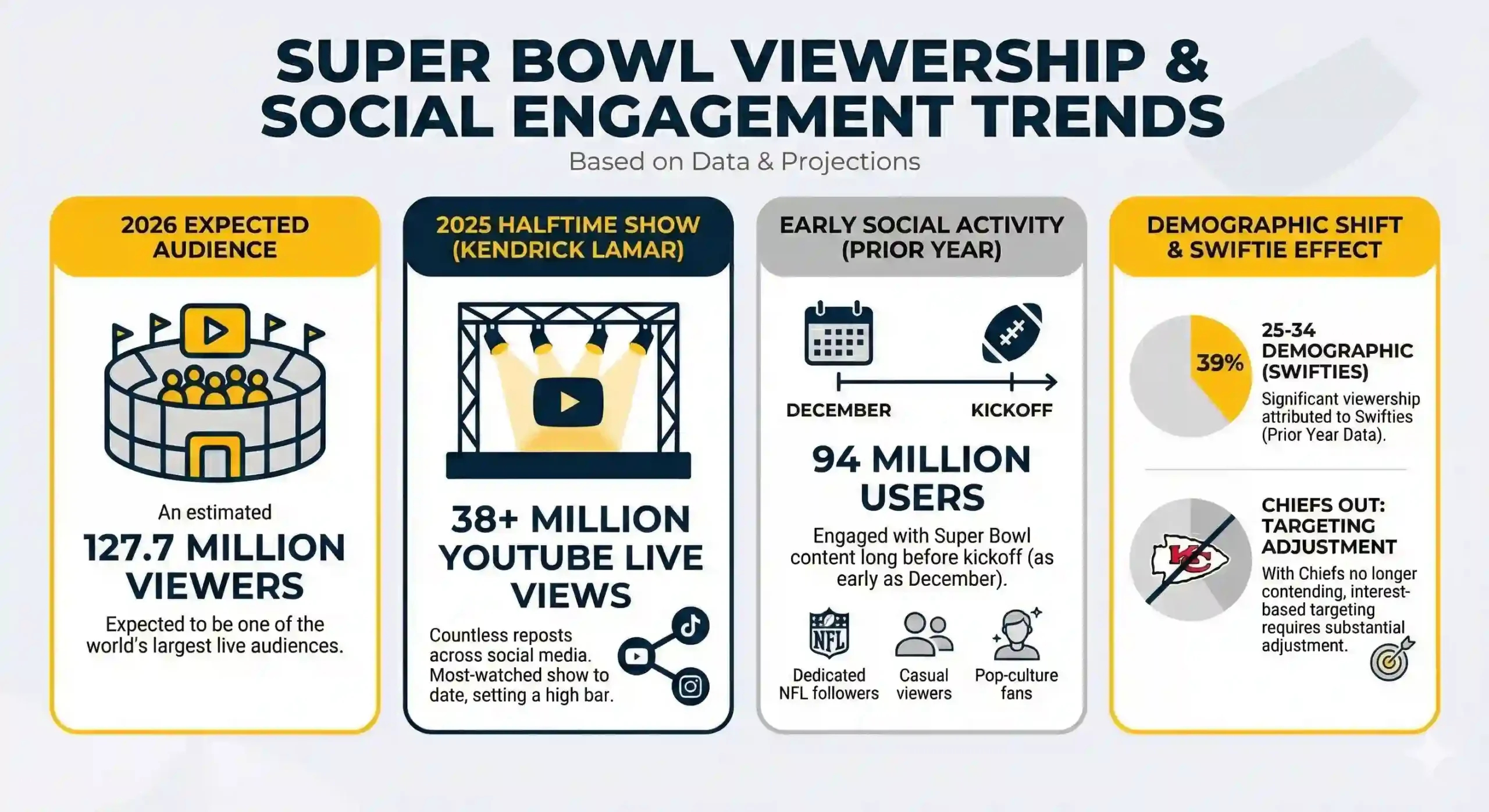
- Targeting sports and casual viewers: Your Super Bowl marketing strategy should not be limited to just football enthusiasts. Last year’s audience data showed that Super Bowl–driven social activity reached 94 million users as early as December, long before kickoff. That audience includes not only dedicated NFL followers, but also casual viewers, and even pop-culture fans like Swifties who will be engaging with NFL content.
- The cost of one second of a TV ad spot can already do miles for your social campaign. With platform efficiencies ranging from 15% to 40%, strategic allocation during Q1 and Super Bowl week can maximize your ad spend.
- Winning by optimizing: Implement a three-phase approach to sustain attention, and see your campaigns achieve view rates of up to 70% when strategies are timed effectively.
Jump to Section
What’s the Play?: 2026 Super Bowl Marketing Strategy for Social Media
A Super Bowl ad remains the most expensive 30-second placement in U.S. media, with Super Bowl commercials now selling for around $8 million. Sure enough, the cost of Super Bowl advertising delivers visibility, but it doesn’t automatically move the needle. Even with the NFL’s global audience, a single TV spot can still fall short on results if not backed by the right strategy.
That’s why the Super Bowl marketing strategy for 2026 is built for a multi-platform audience. Brands are leaning into the proven YouTube, TikTok, and Meta ecosystems to turn Super Bowl moments into sustained engagement and powerful results.
Super Bowl viewers no longer experience the game only on TV, but through short-form video and influencer content across social platforms. As this behavior accelerates in 2026, brands are leaning into social media campaigns to capture attention beyond the broadcast.
Expanding the Audience Targeting Bracket
An estimated 127.7 million viewers are expected to watch the Super Bowl 2026, making it one of the largest live audiences in the world. Kendrick Lamar’s 2025 Halftime Show already set a high bar, achieving over 38 million YouTube live views and countless reposts across social media, becoming the most-watched show to date.
When Bad Bunny hits the stage this year, attention won’t just be on the field, it could be everywhere. Viewers will be watching clips, reactions, highlights, and Super Bowl commercials across their mobile devices, whether they’re at home, at work, or following along globally.
This is why modern Super Bowl marketing campaigns no longer rely only on ads during the broadcast. Winning brands run social media campaigns before, during, and after game day, using platform-specific creatives and dedicated posts to capture attention while the conversation is happening.
Therefore, you’re no longer limited to just football fans. Here’s how you can expand your Super Bowl marketing strategy to reach both sports-driven and culture-driven audiences.
Sports Audiences: The “Hardcore” Fans
For this group, watching the NFL Super Bowl is non-negotiable. These viewers are actively following teams, tracking stats, checking fantasy football lineups, and consuming expert analysis. They search for highlights, watch breakdowns, and engage with content that dives deep into the game itself.
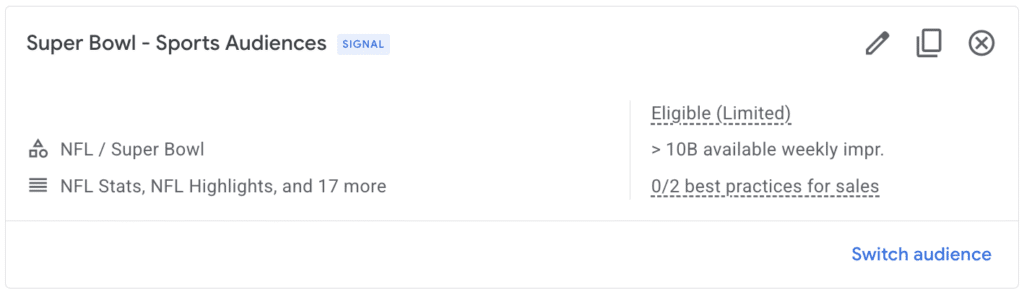
This is where highly targeted Super Bowl advertising shines. Platforms like YouTube and Meta allow brands to build audiences based on:
- NFL and team-specific interests
- Fantasy football participation
- Sports content consumption
- Search behavior around the Super Bowl
If your brand is promoting things like sports bar viewings, food bundles, betting offers, or Super Bowl watch-party deals, this group is essential to your Super Bowl marketing strategy.
With Demand Gen campaigns, you can also control where your Super Bowl ads appear. For example, you can ensure your videos appear alongside NFL highlights or football commentary on YouTube. Even non-sports brands can benefit from including this segment in their Super Bowl social media campaigns, because this audience is already primed to engage.
Casual Viewers and Followers: The “Hype” Crowd
Can brands engage Super Bowl casual viewers who are not exactly avid sports fans? Not even close.
In fact, casual viewers often drive the largest volume of engagement in Super Bowl marketing campaigns. Last year’s viewership statistics showed that only 58% of Super Bowl watchers are actually excited to watch the Super Bowl, with the remaining viewers mostly there for the atmosphere: tuning in for the halftime show, the parties, and the Super Bowl commercials themselves.
This is where culture takes over.
During Super Bowl 2025, pop-culture moments, such as the “Taylor Swift effect,” dominated social conversations. Celebrity sightings, viral reactions, and halftime performances often generate more social media engagement during the Super Bowl than the game itself.
For Super Bowl 2026, the cultural pull shifts again. With Bad Bunny headlining the halftime show and Charlie Puth performing the national anthem, massive fan bases will be watching, even if they don’t care who wins the game.
That makes this group equally valuable for Super Bowl social media marketing strategies.
Your marketing ideas for these audiences don’t need to be about football. They need to be about the moment:
- Halftime show reactions
- Watch-party content
- Celebrity moments
- Commentary on Super Bowl ads
- Real-time trends and memes
By aligning your Super Bowl social media posts with what people are actually discussing, brands can capture a massive reach without paying the full cost of a Super Bowl ad.
Social Media is Where Super Bowl Audiences Are
Over 70% of Super Bowl viewers engage with a second screen during the broadcast. That behavior alone completely changes how your Super Bowl marketing strategy should be built in 2026.
So, how do you own the conversation while everyone is watching on both large and small screens?
This is where social media campaigns become a force multiplier for your Super Bowl ads. When a competitor airs an $8 million Super Bowl commercial, millions of viewers immediately turn to Super Bowl social media to:
- Search for extended cuts
- Watch replays on YouTube
- Share reactions on TikTok
- Meme and critique the ad on Instagram and Facebook
That moment, when attention shifts from the TV to the phone, is where modern Super Bowl advertising is won.
Further Reading
Using YouTube CTV Ads from Awareness to Conversions
Connected TV (CTV) ads are gaining traction as larger screens offer an impactful way to reach new audiences. But is CTV only effective for awareness, or can it also drive lower-funnel actions and support conversion-focused campaigns?
Executing Your 2026 Super Bowl Marketing Strategy
To dominate the second screen during Super Bowl 2026, brands need platform-specific tactics tailored to where audiences spend their time. Based on 2025 performance data, the most effective Super Bowl marketing strategy requires agility and customization for each platform. Success hinges on a unique marketing strategy tailored to the distinct audiences and algorithms of every social channel.
TikTok: The Viral Engine
TikTok thrives on real-time reactions, memes, and viral moments — the perfect environment for Super Bowl social media campaigns. In Q1 2025, we observed TikTok CPMs remaining steady in the $2.43-$3.54 range, making it an effective platform for mass awareness.
- Strategy: At this point, you should have already started leading some ads toward the Super Bowl moment. Standby for trends this quarter, as last year saw less competition due to TikTok’s uncertainty and advertisers shifting to other platforms. Clicks campaigns achieved up to 70% efficiency during Q1, with even lower trends in January; a window of opportunity to maximize early engagement.
- Focus: Influencer ads are critical in 2026. Authenticity over polish drives engagement. For example, Carl’s Jr. partnered with Alix Earle, sharing behind-the-scenes clips and ad sneak peeks on Instagram, achieved 91% follower growth and 47% engagement rate. Start influencer collaborations early to gain momentum.
- Cost: Advertising costs on TikTok definitely reflect the cheaper costs compared to vying for a Super Bowl commercial. Even a month-long campaign can cost less than a single second of TV airtime, making it a cost-effective option for a Super Bowl social media campaign.

YouTube: The Replay Hub
YouTube is where the post-event hype lives. Viewers flock to watch Super Bowl commercials, halftime show replays, and commentary, creating an extended window for engagement.
- Strategy: Use contextual targeting around the Super Bowl, NFL, and sports-related content. Pre-game analysis, post-game commentary, and ads during the Super Bowl all offer high-intent contexts for your campaigns.
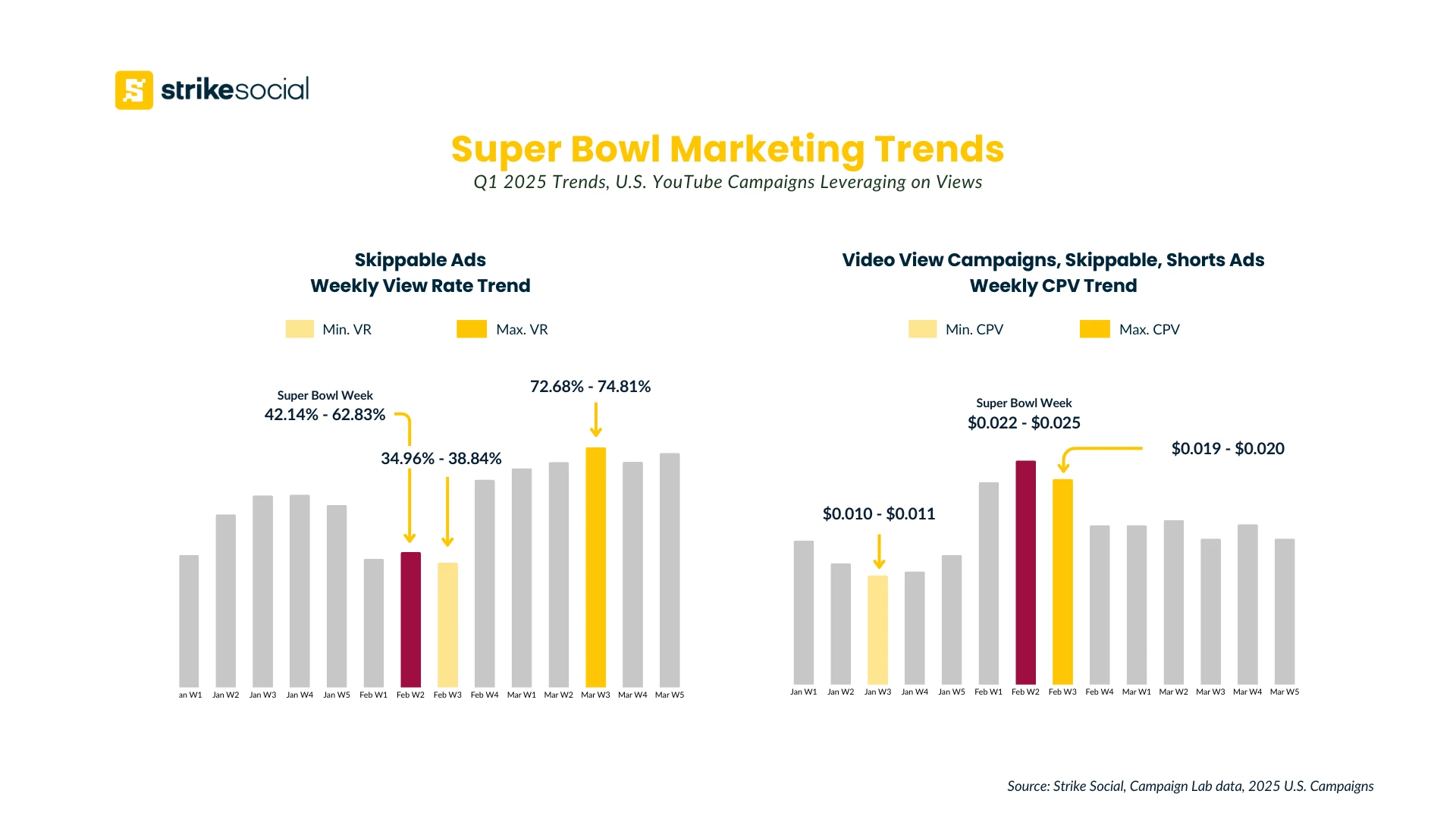
- Focus: Views campaigns perform well both before and after the game, with view rates of 56–64% up to three weeks in advance. Skippable campaigns maintain steady performance, with 64–70% view rates throughout February. Maintain momentum after the Super Bowl to capitalize on ongoing discussions and extended engagement.
- Cost: Brands can achieve efficient CPVs of 15% to 38% leading up to the game, with post-event weeks still offering up to 40% efficiency. YouTube provides a high-value window to maximize exposure beyond TV.
Facebook: The Traffic Engine
While YouTube drives views, Facebook drives action. Clicks, conversions, and direct engagement are the focus here, making it ideal for lower-funnel Super Bowl marketing campaigns.
- Strategy: Build strong top and mid-funnel campaigns to prime users for action during Super Bowl week and beyond. Incorporate UGC, influencer-driven content, and strong retargeting to capture interested audiences and convert them. We’ve seen this in effect, in real-time, utilizing influencer campaigns, and have achieved up to 70% CPLC efficiency on Meta platforms.
- Focus: Clicks-focused campaigns drive results with retargeting and lookalike audiences. Utilize Ad Manager’s robust capabilities to engage users who have previously shown interest through retargeting, and acquire similar high-potential customers using lookalike audiences.
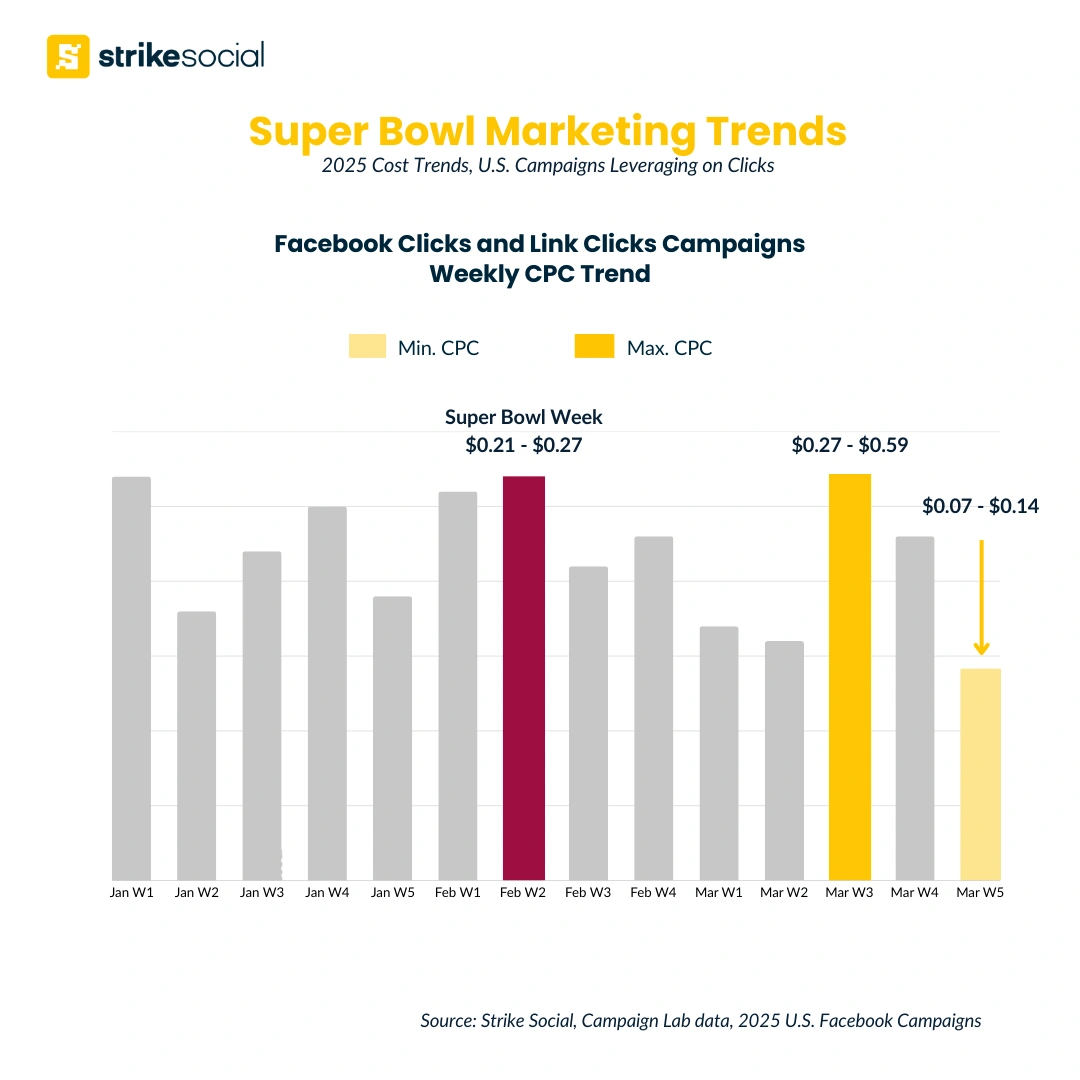
- Cost: CPCs peak during Super Bowl week, but the surrounding weeks see 16–30% higher efficiency, making them prime windows for running sustained campaigns.
Strategic Blueprint to Winning 2026 Super Bowl Advertising Without a TV Spot
What strategies do advertisers use to make their Super Bowl social media ads successful? It follows a three-phase marketing strategy framework, which we have built to help you ramp up and sustain momentum even before and after the event passes.
Here’s how to execute Super Bowl advertising best practices in 2026:
Phase 1: Pre-Game Hype
Timing: Jan 15 – Feb 7
Start building awareness and narrative early to position your brand top-of-mind before the game even begins. Utilize platform-specific strategies to seed content, expand your audience, and establish retargeting pools for game day.
If you plan to drive Facebook audiences to click campaigns during Super Bowl week, launch in advance to take advantage of lower CPCs and build momentum leading into the game. This pre-game kickoff also allows you to craft content tailored to both sports fans and casual audiences, thereby increasing engagement before the Super Bowl even begins.

Phase 2: Game Day
Timing: Feb 8
Game day is when attention peaks. Prepare standby ad sets for any potential outcome, from team wins to viral halftime moments, so your campaigns are ready to react in real-time.
- Execute and optimize Super Bowl social media posts for engagement as events unfold.
- Capture trending conversations, memes, and highlights.
- Maintain ad delivery even as costs rise during Super Bowl week, because active campaigns during the game have the highest visibility and engagement.
The goal is to turn fleeting attention into immediate interaction with your brand.
Phase 3: Post-Game Saturation
Timing: Feb 9 – Feb 15
The day and week after the Super Bowl see massive spikes in searches for highlights, recaps, and viral moments. For marketers, this phase is where retargeting and sustained engagement drive real results.
- Aggressively retarget anyone who engaged with your Super Bowl ads or visited your profiles.
- Extend campaigns to capture viewers searching for Super Bowl social media posts, ad reactions, and commentary.
- Utilize post-game momentum to turn engagement into customer relationships.
Data from previous years shows that Super Bowl marketing campaigns continue to deliver strong efficiency and performance well after the game, making post-event activation an essential part of your Super Bowl marketing strategy throughout Q1.
Be on the Offense This Super Bowl 2026
While the cost of advertising during Super Bowl 2026 remains high for TV, the digital field is wide open for brands that know how to play smart. The most memorable campaigns won’t necessarily come from the biggest checks; they will come from those that optimize with a 360-degree Super Bowl marketing strategy: combining social media campaigns, influencer content, and timely engagement to capture attention before, during, and after the game.
Don’t just watch from the sidelines. The brands that dominate Super Bowl 2026 will be the ones turning moments into conversations, and conversations into measurable results.
Ready to build a championship-tier strategy? Contact Strike Social to construct your 2026 roadmap.

Article by
Lee Baler, Strike Social’s VP of Sales & Strategy
Lee leads global strategy, helping clients and agencies maximize YouTube and paid social performance. Constantly tracking industry trends, he translates insights into strategies that help brands stay competitive and achieve sustained profitability.


