

Strike Overview
- The algorithm is the audience: Social media marketing trends in 2026 emphasize aligning your creatives with the audience, not the other way around. While AI targeting might sometimes push your ads toward irrelevant groups, your creative content needs to be meticulously aligned with your target audience.
- Keeping audiences engaged: With users spending more time in short-form videos and social feeds, marketing strategies must focus on holding attention and facilitating in-app actions. Shoppable videos are becoming e-commerce brands’ must-have this year.
- AI is your ally, not your autopilot: AI-assisted strategies can boost campaigns, but control should remain in your hands. This 2026, advertisers must use AI as a support tool, not a replacement for decision-making.
Jump to Section
- 1. Creative Has Officially Replaced Targeting
- 2. Short-Form Video Is Still Unstoppable
- 3. Lo-Fi vs. Polished (The Ugly Ad Era)
- 4. Contextual Discoverability
- 5. Shoppable Videos without Leaving the App
- 6. Shopping with AI Agents
- 7. Founder-Led Marketing & Employee Advocacy
- 8. Conversational Content and Marketing
- 9. First-Party Data Strategies Matter More Than Ever
- 10. AI-Assisted Strategy, Not Just Automation
10 Social Media Marketing Trends for 2026: What’s Driving Growth Now
The social media marketing trends emerging in 2026 reveal a clear paradox shaping performance across platforms: while AI adoption in marketing has accelerated at unprecedented speed, audience demand for personalized and authentic content has never been stronger. AI usage among marketers is up more than 180%, driven largely by ideation, copy development, and optimization workflows. Yet, reliance on fully automated creative generation remains limited, especially where brand trust and engagement are on the line.
As you finalize your 2026 media mix, this tension is impossible to ignore. On one side is the pressure to scale faster through AI and automation. On the other hand, there is growing consumer fatigue with overly polished, synthetic content. The challenge for modern advertisers is no longer choosing between automation and authenticity, but designing a social media marketing strategy that can effectively deliver both.
In 2026, the era of “hacking the algorithm” is effectively over. Major social media marketing platforms have matured to the point where signals increasingly align with real audience behavior. In practice, this means the algorithm is no longer something to outsmart; the algorithm is the audience. Performance now depends on how well brands align paid social media advertising, creative strategy, and messaging with genuine user intent.
This is your executive guide to the latest social media marketing trends shaping 2026, covering content formats, platform shifts, and strategic implications, and how brands are translating these trends into growth and revenue.
Creative and Targeting Trends
Among the latest trends in social media advertising, the most consequential shift in 2026 is not a new feature release or ad format. It’s a fundamental change in how platforms function and how advertisers must adapt their social media marketing strategy. The mechanics of targeting and delivery have been rewritten by AI-driven systems that prioritize creative signals over manual audience inputs.
1. Creative Has Officially Replaced Targeting
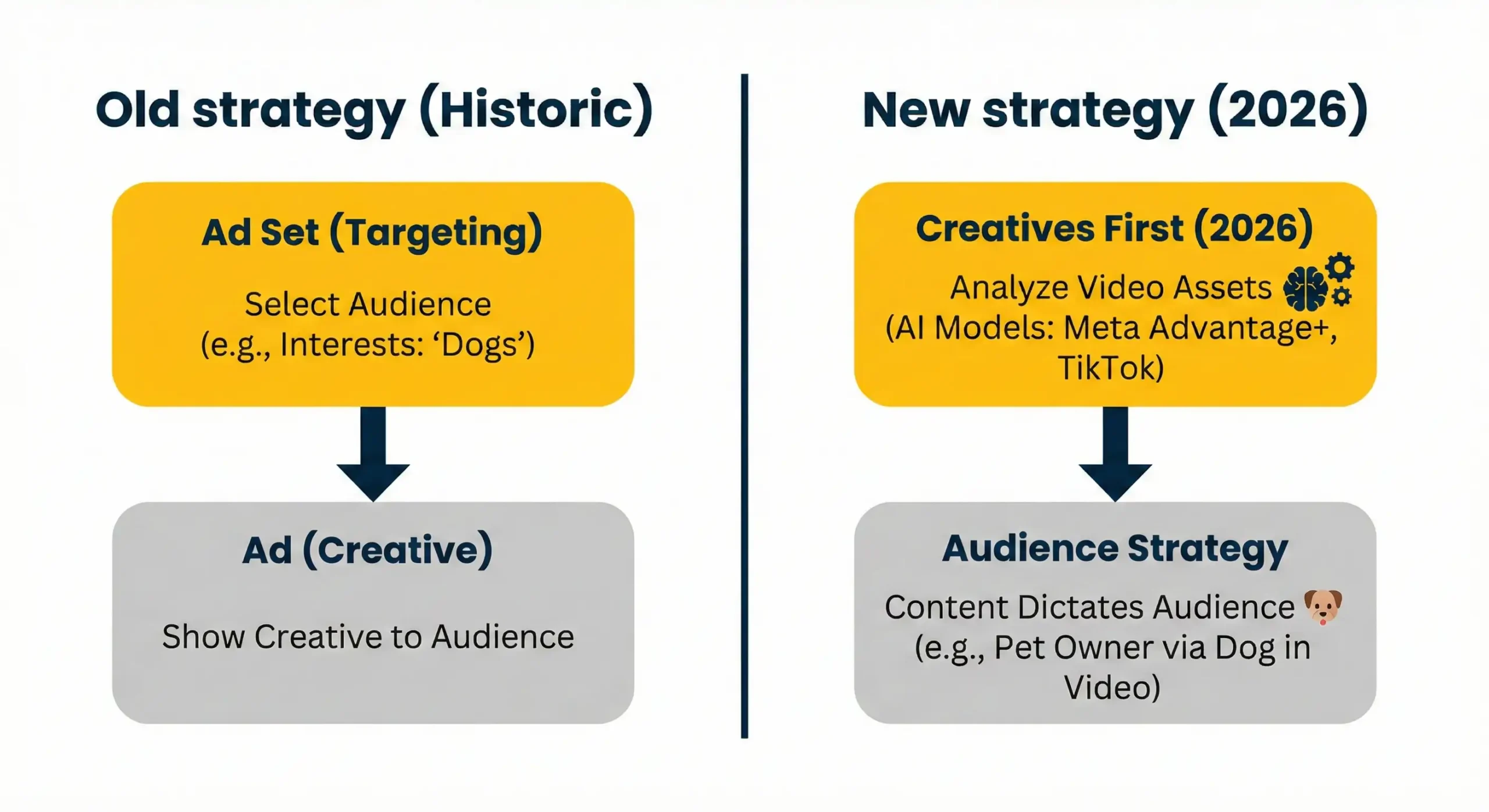
Historically, targeting lived at the ad set level, and creative followed. Advertisers selected an audience first, then delivered messaging to that predefined group. In 2026, that model no longer reflects how advertisers should operate.
AI-led systems, such as Meta’s Advantage+, now analyze creative assets directly. These models interpret visual cues, audio, captions, and contextual signals to determine who should see the ad. In practice, the creative now dictates the audience. If the goal is to reach pet owners, selecting interest-based targeting matters far less than showing a dog, demonstrating pet behavior, or addressing a pet-specific problem within the content itself.
This shift represents a broader trend analysis of social media platforms: success now depends less on audience groups and exclusions and more on producing content that clearly communicates intent to both the algorithm and the user.
2. Short-Form Video Is Still Unstoppable
Despite repeated predictions of saturation, short-form video remains one of the most durable social media advertising trends shaping 2026. The “TikTokification” of platforms has not slowed; it thrives. Short-form formats are now deeply embedded across TikTok, Instagram, YouTube, Facebook, and even LinkedIn.
With YouTube Shorts projected to surpass 70 billion daily views and Instagram Reels continuing to dominate in-app screen time, short-form video has evolved beyond a mere awareness tactic. Video content trends for social media ads in 2026 show that brands are increasing investment in short-form formats as full-funnel performance drivers, capable of influencing consideration, conversion, and retention.
High-performing short-form content mirrors organic behavior: fast hooks, mobile framing, platform-specific pacing, and minimal friction. Rather than interrupting the feed, the most effective ads blend into it, aligning with how users already consume content.
3. Lo-Fi vs. Polished (The Ugly Ad Era)
Another defining shift in current social media marketing trends is the declining effectiveness of overly polished creative. In 2026, highly produced ads increasingly struggle to hold attention. Audiences have learned to identify (and ignore) content that feels overly branded or sales-driven.
User-generated and creator-led assets consistently outperform traditional brand creatives, with engagement rates reported to be 8.7x higher in certain verticals. Influencer-driven and raw in-feed content continues to play a significant role in purchase decisions, reinforcing broader influencer marketing trends for 2026.
As a result, brands are leaning into lo-fi execution: mobile-shot footage, minimal editing, natural lighting, and conversational delivery. In 2026, authenticity becomes more of a performance signal, not just a branding preference.
How Audiences Will Discover Brands
Social platforms are increasingly driven by interest and intent. Audiences signal what they care about through their behavior, searches, and engagement patterns, and platforms optimize delivery around those signals. Understanding how intent is expressed in 2026 is now central to any effective social media marketing strategy.
4. Contextual Discoverability
The shift in digital marketing is moving away from channel distribution toward contextual discoverability. For younger generations, particularly Gen Z and Gen Alpha, platforms like TikTok and Instagram are now the primary search engines.
This means optimizing for social search should no longer be a low priority. For instance, a video that directly addresses a specific query, such as “best budget skincare for winter,” is more likely to rank in search results.
Therefore, your social media marketing strategy for 2026 must be restructured to focus on explicit relevance. This includes incorporating keyword-rich captions, on-screen text, and voiceovers that clearly articulate the user problem your content solves.

5. Shoppable Videos without Leaving the App
The divide between discovery and purchase has effectively disappeared, fueling social commerce growth in 2026. This expansion is driven by the elimination of friction, as evidenced by the surge in shoppable videos, allowing direct purchases from platforms like YouTube Shorts and TikTok.
The key is to keep audiences interested in an ad without having to leave the app to finalize a purchase. Users now expect to tap a product tag within the same video and complete their payment instantly, utilizing options like Apple Pay or other platform-native digital wallets.
Further Reading
Drive Views, Clicks, and Conversions with TikTok Shop Ads
TikTok Shop Ads allow brands to meet users where discovery already happens. Products appear naturally across feeds and live streams, creating a frictionless path from inspiration to purchase. With checkout built directly into the platform, users can complete purchases quickly, turning views into measurable revenue.
6. Shopping with AI Agents
As AI agents become a default interface for research, planning, and purchasing, consumers are increasingly turning to platforms like Meta AI to guide buying decisions.
Queries such as “Plan a dinner party for six and add the ingredients to my cart” signal a fundamental change in how brands are discovered. For many retailers, this shift is being enabled by AI agents for small businesses, which help automate product discovery, recommendations, and purchasing assistance without requiring enterprise-scale infrastructure.
In this environment, visibility is no longer limited to feeds, search results, or ads. It extends to how well your brand can be interpreted, ranked, and recommended by Large Language Models (LLMs). This makes having a clear AEO strategy essential.
Human-Led & Community-First
In a world flooded with AI-generated slop, “human” is a premium feature. Audiences may appreciate AI for speed and convenience, but when it comes to trust, influence, and purchase decisions, people continue to respond most strongly to content that feels personal and credible.
7. Founder-Led Marketing & Employee Advocacy
Among the top social marketing trends in 2026 is the decline of faceless corporate communication. Founder-led storytelling and employee advocacy are emerging as high-impact growth levers, particularly in crowded and trust-sensitive categories. Community-driven and authentic messaging consistently outperforms traditional brand-led creative, with some generating up to 25% more leads.
Roughly 76% of ad audiences report higher trust in content generated by employees compared to brand-only messaging. This is especially relevant for B2B, where the top social media marketing strategy in 2026 involves activating internal subject matter experts: founders, leaders, and frontline employees, to represent the brand publicly.
8. Conversational Content and Marketing
Broadcasting is out; dialogue is in. Conversational content and marketing means treating the comments section as a revenue channel.
Nearly 27% of consumers already interact with brands through chatbots and direct messages, and 52% of customers who receive real-time responses report higher brand loyalty. Immediate, conversational engagement shortens decision cycles and builds trust at scale.
Leading brands are combining automation with human oversight to trigger private conversations directly from public engagement. Tactics such as prompting users to send a message or comment serve two purposes:
- signal strong engagement to platform algorithms, and
- transition users into high-intent, one-to-one interactions where conversion is more likely.

Data Independence & AI Strategy
Platforms continue to innovate at an unprecedented pace, but advertisers must ask: Can we fully rely on platform data?
Success now requires owning your audience data and using AI as an assistive tool, not a replacement for strategic oversight.
9. First-Party Data Strategies Matter More Than Ever
With third-party cookies disappearing and privacy regulations tightening globally, first-party data has become a core pillar of paid social media advertising and broader digital marketing trends. Platforms reward brands that provide accurate signals about their actual customers, thereby improving AI-driven ad delivery and campaign performance.
Key areas to maximize your first-party data in 2026 include:
- Email and Contact Information: Leads collected through gated content, newsletters, or lead magnets can be utilized to create lookalike audiences. Studies show that 84% of users still allow API-based data syncing, giving advertisers a valuable opportunity to expand reach.
- Behavioral Engagement: Metrics such as likes, comments, shares, DMs, and view duration provide actionable insights. Engaged users on your social profiles are an invaluable first-party audience for your paid campaigns.
- Purchase and Transaction History: Post-click conversions, online purchases, and offline CRM events feed directly into ad platforms to refine audience targeting and improve outcomes.
10. AI-Assisted Strategy, Not Just Automation
AI in 2026 has evolved beyond “generate this for me” workflows. Marketers should use AI to support strategy rather than full automation, combining machine speed with human judgment. This represents a critical trend in how AI will impact social media advertising in 2026.
- Analysis & Research: Tools like ChatGPT and Gemini can process thousands of data points, simulate audience segments, and summarize competitor strategies. AI excels at spotting anomalies and generating insights quickly.
- Content Creation: AI can provide starting points for copy, captions, and even media plans. However, human oversight is essential to preserve brand voice and context. Without careful editing, AI content can produce generic or irrelevant messaging.
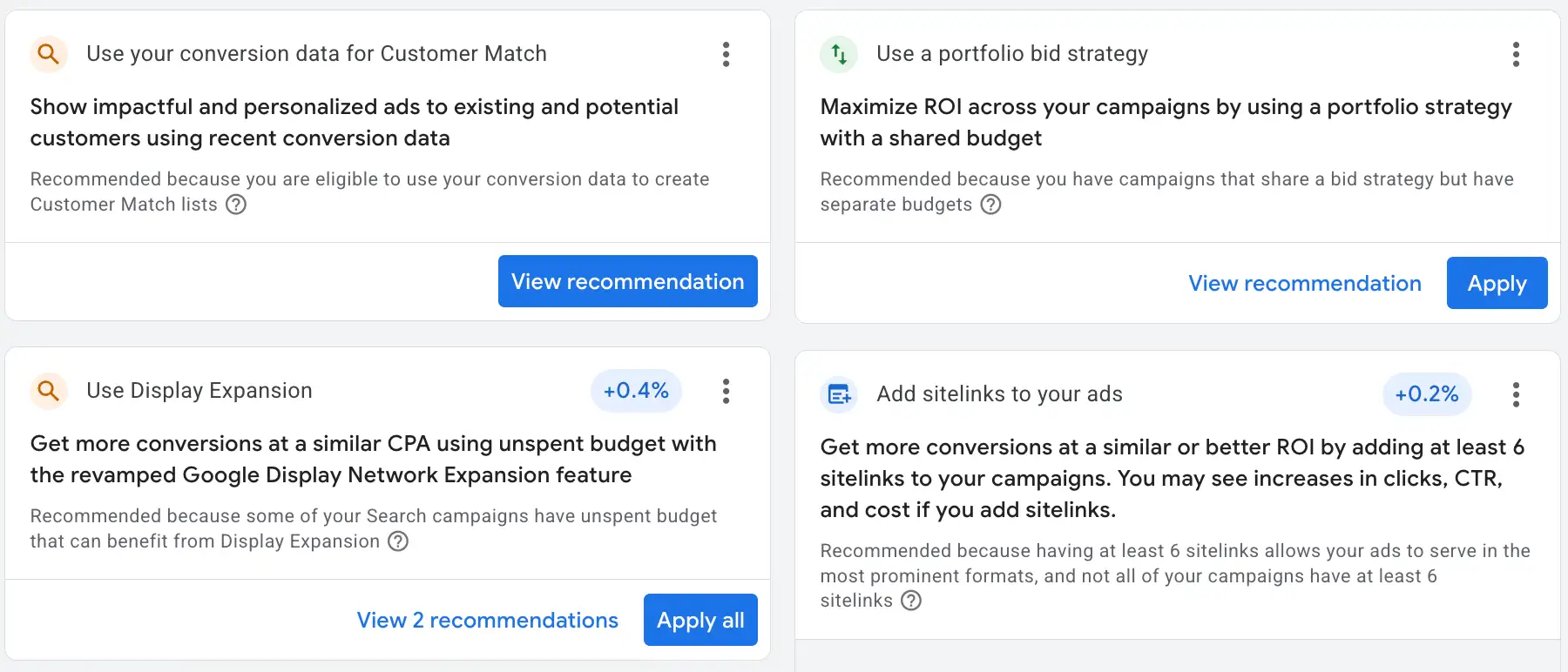
- Campaign Optimization: Native AI recommendations from platforms like Google often focus on cost metrics such as CPC or CPM. While useful, these suggestions don’t account for your business’s margins or strategic objectives. Top strategists use AI to assist with insights but maintain manual control over deployment to ensure profitability.
The 2026 Marketer’s Mandate
The latest digital marketing trends for 2026 present a clear choice. You can continue trying to outsmart the algorithm with outdated technical hacks, or you can embrace the new reality: the platforms have done the heavy lifting on the backend.
Your job now is to feed them the right fuel. That means creative that resonates, data that is owned, and content that is undeniably human. The brands that drive growth this year will be the ones that stop interrupting the feed and start adding value to it.
Set your social media marketing strategy up for success in 2026. Contact our team today for a personalized walkthrough of how we leverage these trends to innovate, optimize, and generate savings across your campaigns.

Article by
Lee Baler, Strike Social’s VP of Sales & Strategy
Lee leads global strategy, helping clients and agencies maximize YouTube and paid social performance. Constantly tracking industry trends, he translates insights into strategies that help brands stay competitive and achieve sustained profitability.


