

Strike Overview
- Bigger changes, better performance: Forget the old mindset: Facebook ads optimization no longer works by constant major tweaks; with Meta’s evolving tools and innovations, smarter strategies are required.
- Shifting ad optimization strategies: Audiences aren’t fixed, and AI isn’t a set-it-and-forget-it solution. We show how to intelligently guide campaigns without relying on a single rule.
- Should you trust AI tools?: With Meta pushing Advantage+ campaigns, learn how to smartly utilize AI while retaining control over creatives, budgets, and delivery.
Jump to Section
What Works for Facebook Ads Optimization (and What’s a Myth)
Facebook ads optimization isn’t a myth; yet many advertisers struggle because they’re optimizing against the system instead of with it. When performance stalls, the issue is rarely that optimization doesn’t work. More often, it’s that outdated tactics are interfering with how Meta now delivers ads.
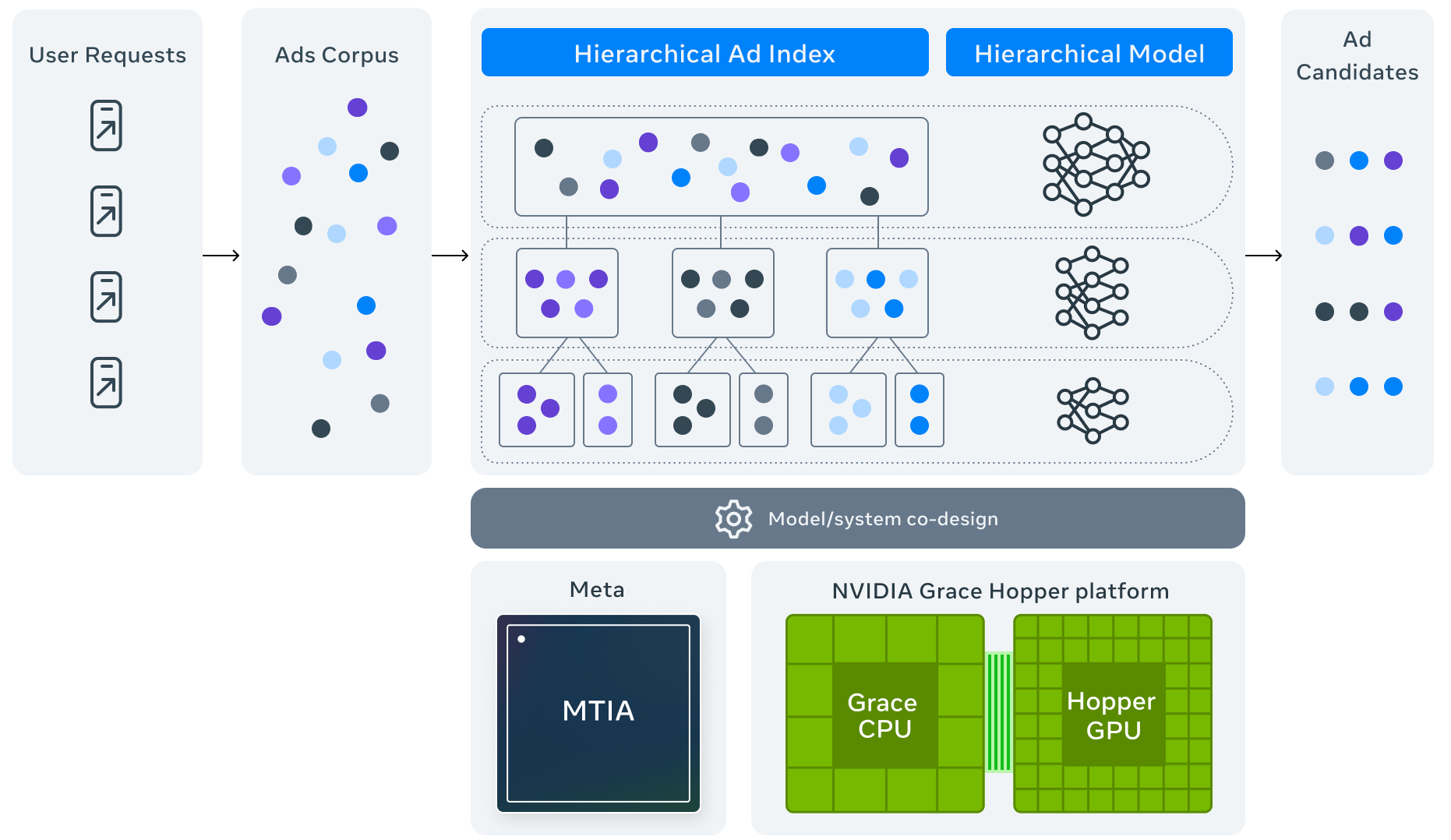
The reality is that Meta ads optimization has fundamentally changed. Tactics that once defined campaign optimization, such as hyper-granular audience segmentation, excessive ad set duplication, or blindly relying on automated budget distribution, can now limit delivery and suppress learning if applied incorrectly. With the rollout of the Meta Advantage Suite, advances in campaign budget optimization, and innovations like Andromeda, Facebook’s delivery system has become far more dependent on signals, creatives, and scale than manual control.
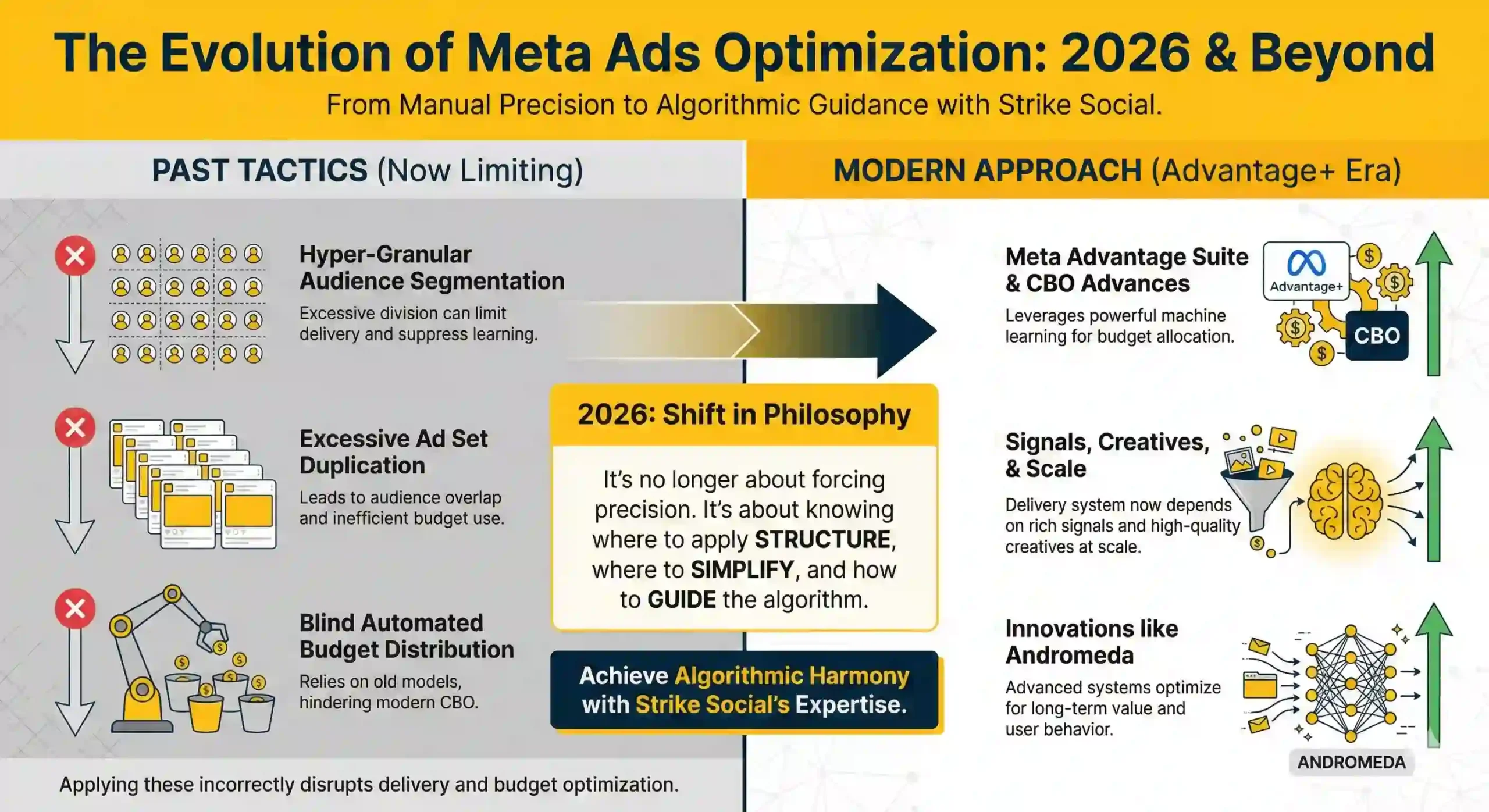
In 2026, Facebook ads optimization is no longer about forcing precision. It’s about knowing where to apply structure, where to simplify, and how to guide the algorithm without disrupting ad delivery or budget optimization.
Below, we break down what actually works when optimizing Facebook ad performance, and which myths are quietly holding performance back.
Myth #1: “Daily Optimization Means Constantly Tweaking Settings”
❌ The Myth: To improve performance, you must be in Ads Manager every hour of every day: swapping creatives, editing headlines, and narrowing audiences.
✅ The Reality: Steering vs. Rebuilding
Daily optimization is definitely still a factor, but the specific levers we pull have changed.
Being in the account, constantly tweaking targeting or swapping creatives doesn’t improve Facebook ads optimization. It actually disrupts performance by resetting the learning phase and killing campaign momentum.
Instead, focus on adjustments that guide performance safely without confusing the algorithm. That means prioritizing bids and budgets over structural changes.
- Steering: Adjusting a budget by 10% or tweaking a manual bid cap. Think of this as guiding a car while it’s moving; small corrections that improve performance without disruption.
- Rebuilding: Changing targeting or pausing a main creative. This is like tearing the engine apart while driving at 100 mph; it triggers relearning and slows results.
How to optimize ad spend effectively:
- Avoid major structural changes that interrupt delivery, especially during the early days of the campaign.
- Use budget optimization strategies to protect downside (Cost Caps) and capture upside (scaling budgets) without triggering the learning phase.
- Focus on steady improvements through ad set budget optimization (ABO) or campaign budget optimization (CBO) rather than constant creative or audience edits.
Myth #2: “You Need Complex Audience Targeting to Scale”
❌ The Myth: You need to find the “perfect” audience group so your ads will perform.
✅ The Reality: Creative Is The Targeting.
Facebook ad set optimization isn’t about micromanaging audience segments. It’s about letting your ad creatives do the heavy lifting.
- If your video creative is a UGC or influencer ad, your audience should broadly include people who will naturally resonate with that style.
- If your creative is a polished, brand-focused ad, you might target broader professional groups or older age brackets, but still avoid overcomplicating segments.
The algorithm now evaluates the content of your creative (pixels, audio, text, and motion) to predict who is most likely to engage and convert. In other words, creative optimization drives audience optimization, not the other way around.
How optimizing your creative for your audience works:
- Focus on making your videos and images resonate with your ideal customer archetype.
- Avoid over-engineering audience parameters; broad targeting allows the system to dynamically optimize who sees your ads.
- By letting creative guide delivery, you maximize reach and engagement while keeping advertising optimization in Facebook efficient.
Further Reading
How Meta Advantage+ Audience Targeting Works
As one of Meta’s AI-powered targeting tools, Advantage+ Audience is designed to dynamically find users most likely to deliver results. It builds from your core audience inputs, then intelligently broadens reach using engagement history, conversion data, and real-time behavioral signals.
Myth #3: “CBO Is the ‘Set It and Forget It’ Solution”
❌ The Myth: Campaign Budget Optimization (CBO) is the smartest way to spend because AI always knows best.
✅ The Reality: CBO Often Starves Potential Winners.
One of the most common questions is: “Does Facebook Campaign Budget Optimization (CBO) still work?”
The answer is yes, but blindly relying on it is often a lazy approach to Facebook ads optimization.
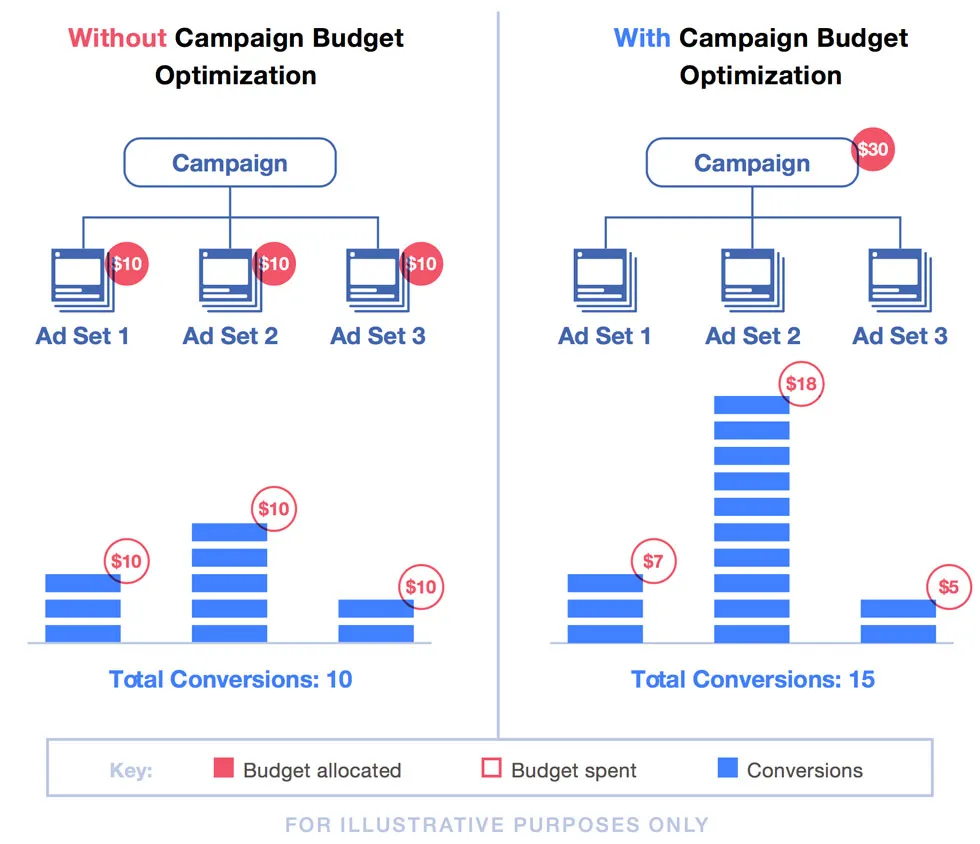
CBO (now Advantage+ campaign budget) tends to latch onto one ad set early, the “easy win”, and dumps the majority of the budget there. This deprives your other concepts of a budget, leaving them with no budget to execute throughout the campaign flight.
How budget optimization can work better:
- Use Advantage+ Campaign Budget (CBO) for Testing
- Force the system to spend evenly across all concepts. This helps you identify high-performing creatives or audiences.
- While CBO will initially favor the early frontrunner, closely monitor the performance of all other ads to make informed, early decisions about which concepts to continue.
- Use ABO (Ad Set Budget Optimization) for Scaling
- Once you have identified and validated your winning ads or ad sets, transition them into an ABO structure.
- ABO allows for more precise control over the budget allocation, leading to more efficient and optimized delivery when scaling successful campaigns.
To truly optimize an advertising campaign, you can’t let the algorithm decide what gets tested. Manual pacing, strategic budget allocation, and careful monitoring remain critical, even with advanced AI delivery.
Myth #4: “Find Your One Winning Ad and Scale It”
❌ The Myth: You just need one universal ad to run the whole year.
✅ The Reality: The Andromeda Shift & Volume.
With the release of Meta’s Andromeda engine, the rules of creative optimization have fundamentally changed. The system no longer thrives on a single “winning” ad. It performs best with variation and volume.
Through Andromeda, Meta’s AI creates a personalized experience for every user:
- One person might respond to a static image with a discount code.
- Another might engage only with a UGC video that tells a story.
If you provide just one or two ads, you limit the algorithm’s ability to reach the right users.
How Andromeda can diversify your creatives:
- Instead of running 2–3 ads per ad set, Andromeda’s modern approach to Facebook ads optimization strategies involves curating 20–30 variations.
- This doesn’t mean producing 30 completely different videos; it means applying dynamic creative optimization principles: testing different hooks (e.g,. “Save 15% Today” vs. “Get It At 15% Off”), headlines, visuals, and aspect ratios to increase eligible and high-performing ads.
- More variations generate more data points, speeding up learning and improving advertising optimization for your Facebook ads.
Bottom Line: Let AI guide delivery, but don’t let it restrict your creative output. Broad creative variation combined with Facebook ad set optimization allows the algorithm to find the best-performing ad for each audience segment, helping you fully utilize your ad spend to increase performance.
FAQs: Quick Answers on Ad Campaign Optimization
To optimize effectively, start by ensuring your data is clean:
• Make sure your Facebook pixel is firing correctly and check for any tracking errors. Accurate reporting of ROAS and conversions is mandatory before making optimization decisions.
Next, consolidate your budget:
• Combine smaller campaigns into fewer, larger campaigns to give the algorithm more signal data.
• Use Manual Bids or Cost Caps to protect ROAS while allowing the system to optimize delivery.
Finally, consider expert support for high-scale campaigns:
• Advanced accounts often require 24/7 monitoring to adjust bids, budgets, and creatives in real time. Expert agency support ensures your Facebook ads optimization is not hindered by learning-phase disruptions.
Start by ensuring your objective is set to “Sales” or “Leads” only. If you choose “Traffic”, the campaign will optimize for CPC and CTR, but may not deliver qualified leads or audiences who are ready to make a purchase or submit their information.
Then, lean into Creative Generation. Instead of narrowing your audience, create ads that call out your specific buyer in the first 3 seconds. This allows you to tailor your audience to your creatives, not the other way around (audiences first, then creative production or generation).
Finally, implement CAPI (Conversions API). Capture off-platform data to give Meta’s algorithm the signals it needs to find more high-quality buyers, supporting Facebook conversion optimization.
Follow this chronological checklist to optimize your campaigns without breaking the algorithm:
Sit on Your Hands: Days 0-3
• Avoid pausing ads or changing budgets; the algorithm is in the learning phase.
• Verify your pixels are firing correctly in Events Manager.
• Check if ad sets are spending. If not, check your manual bid or cost cap.
Steer Them Straight: Days 4-7
• Check soft metrics like spend and CPA.
• Soft optimizations include:
• Lower Cost Cap by 5–10% if CPA is too high.
• Raise Cost Cap by 5–10% if spend is too low.
• Focus on budget optimization strategies that guide the algorithm without disrupting learning.
The Weekly Routine: Day 14, 21, 28
• Review ad sets by Amount Spent and CPA trends over the past 7 days.
• Implement granular optimizations only if ad sets are spending but underperforming. Here are some examples:
• Launch a new batch of 3–5 creative variations in an A/B testing campaign. Do not modify existing winners. Add new variations alongside them.
• Check your Marketing Efficiency Ratio (MER = Total Revenue / Total Ad Spend). A healthy MER can justify pushing budgets even if in-platform ROAS appears lower.
Monthly Scaling: Day 30/31
• Consolidate campaign data for the month.
• Move winning creatives from CBO testing campaigns into your “Always On” ABO scaling campaign.
• Combine multiple high-performing campaigns where possible. Larger data pools allow the algorithm to optimize delivery more efficiently.
By following this chronological Facebook ads optimization checklist, you can balance experimentation, budget guidance, and scaling, all without disrupting the algorithm’s learning phase or limiting campaign optimization potential.
Let the Meta Ad Optimization Machine Work
Effective Facebook ads optimization is less about micromanaging and more about guiding the system strategically. The highest-performing ads focus on creative strategy, structured budgets, and measured bid adjustments, not constant tweaks that disrupt learning.
True mastery of Meta ads optimization comes from understanding which levers to steer, like budgets and bids, versus which to avoid tampering with, such as audience targeting or winning creatives. This approach protects ROAS, accelerates learning, and maximizes return on ad spend.
By trusting the platform while strategically guiding performance, you stop fighting the system and start letting it work for you, turning Facebook advertising optimization into a predictable, scalable engine for growth.

Article by
Lee Baler, Strike Social’s VP of Sales & Strategy
Lee leads global strategy, helping clients and agencies maximize YouTube and paid social performance. Constantly tracking industry trends, he translates insights into strategies that help brands stay competitive and achieve sustained profitability.


