

What’s Changing In the DSA to AI Max Transition:
- Keep An Eye on the Timeline: By September 2026, Google will automatically force-migrate all remaining eligible DSA, ACA, and broad match campaigns into AI Max.
- From Crawling to Contextual: Dynamic Search Ads relies on the website content, landing pages, and URL structure. With AI Max’s capabilities, it uses Google’s Gemini models to combine your landing page data with broader, real-time user intent signals to dynamically generate contextually relevant headlines and descriptions.
- Input-Driven Strategy: Despite the heavy emphasis on generative AI, keyword strategy is not obsolete. Keywords serve as foundational intent signals for AI Max, actively steering the algorithm to reach your intended audiences.
Jump to Section

DSA to AI Max: How Will It Impact Your Dynamic Search Ads
The DSA to AI Max upgrade is officially here, marking the end of the keyword-only era for Google Ads. Starting September 2026, Google will transition all eligible Dynamic Search Ads (DSA), Automatically Created Assets (ACA), and broad match campaigns to the new AI Max framework.
For advertisers, the window to migrate on your own terms is open right now. You can proactively transition and port your historical data, or wait for Google’s automatic system to dictate your strategy. At Strike Social, we strongly advise the former to retain control of campaigns as the shift to AI Max becomes official.
See the breakdown of the technology changes and a step-by-step playbook to replace Dynamic Search Ads, so you can keep the helm of your Google paid search strategy.
Why is Google Replacing Dynamic Search Ads with AI Max?
The standard Dynamic Search Ads worked by crawling your website or a specific page feed. Instead of bidding on keywords, you let Google match user queries to your site’s content and automatically generate a headline. While effective at capturing broad traffic, these campaigns often needed human review. They demanded constant vigilance with negative keywords and URL exclusions to prevent wasted ad spend on irrelevant pages.
According to usage statistics, up to 70% of searches are phrased broadly, using only 2-4 keywords. Seasonal shopping searches, such as “travel” and “beach gear,” increase by over 300% each time a season arrives. Thus, Google is transitioning DSA to AI Max because consumer search behavior is becoming more complex and unpredictable.
Google AI Max uses the core logic of Dynamic Search Ads and significantly enhances it. It moves intent inference upstream, utilizing Google’s Gemini models for sophisticated, context-aware creative generation. By layering a wider array of real-time intent signals beyond just your website content, it adapts in real-time.
AI Max vs. DSA: What’s Actually Changing?
AI Max is not a standalone campaign; it is a feature suite integrated directly into standard Search campaigns, changing how query matching and ad creation work at a fundamental level.
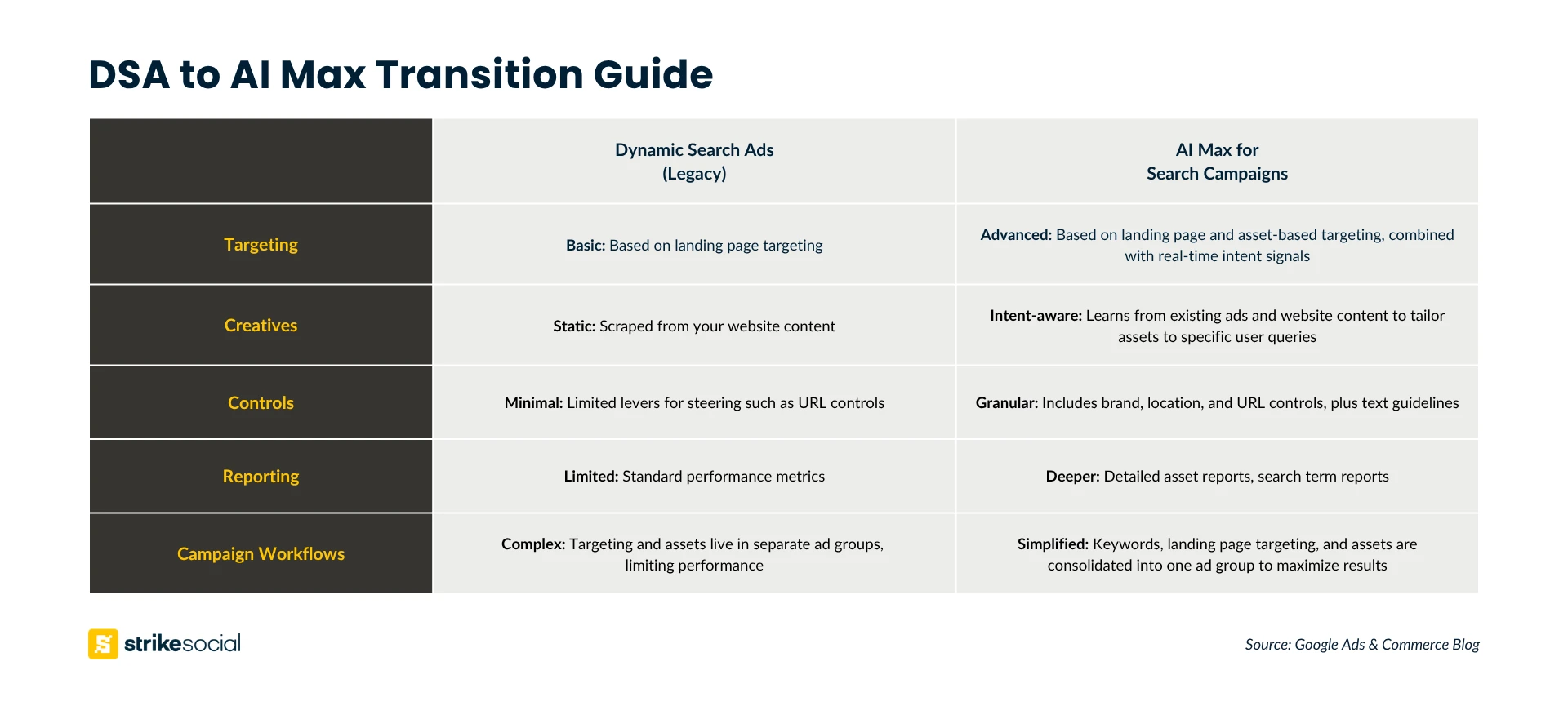
As you prepare for the DSA to AI Max migration, here are the critical shifts in mechanics:
- Targeting & Query Matching: DSA relies entirely on website content and page feeds. AI Max uses website content plus broader user intent signals across the Google ecosystem.
- Creative Generation: DSA auto-generates headlines strictly from page content. AI Max features Gemini-powered text customization that writes contextually relevant headlines and descriptions.
- Campaign Structure: DSA required separate Dynamic Ad Groups. AI Max consolidates this, operating seamlessly within standard search ads.
- Managing Inputs vs Outputs: With DSA, advertisers focused on maintaining ad suitability via extensive negative lists. With AI Max, the focus shifts to managing inputs. Because it combines your assets with real-time audience signals, you must maximize the use of brand safety controls, location parameters, and text guidelines.
- First-Party Data Reliance: AI-driven campaigns experience better liquidity in ad auctions when they are fed first-party data. CRM integrations and offline conversion tracking are required so the algorithm optimizes for actual sales, not just clicks.
What Happens to DSA Campaigns When Upgraded to AI Max
Google has structured this rollout into two phases. Knowing where you are on this timeline determines how much control you retain.
Phase 1 (Now through August 2026):
Google is actively rolling out upgrade tools to help advertisers migrate historical settings and data into new standard ad groups securely. This is the recommended path to avoid losing the learning-phase data you have already collected.
Phase 2 (Starting September 2026):
Google will disable the creation of new DSA campaigns via Google Ads, Ads Editor, and the Ads API. Any remaining eligible Dynamic Search campaigns will be forced into the new framework.
- For DSA Users: Your dynamic ad groups will transition to standard ad groups, with search term matching, text customization, and final URL expansion enabled.
- For ACA Users: Campaigns will be upgraded to AI Max, with search term matching and text customization enabled by default.
- For Broad Match Users: Campaigns will upgrade with search term matching enabled by default.
Further Reading
Understanding AI Max for Search Campaigns
As paid search evolves, Google Ads introduces AI Max for Search to better align ads with real-time user intent. This approach enhances how campaigns are delivered, optimizing both targeting and placement dynamically. Explore how it works, how to activate it, and how it compares to traditional Search and Performance Max campaigns.
Step‑by‑step Guide to Upgrading Dynamic Search Ads to AI Max
Follow this four-step migration checklist to ensure your campaigns maintain the same level of performance as you transition from DSA to AI Max.
Step 1: Audit and Export Current Performance
Before modifying your live campaigns, establish a benchmark. Pull at least 90 days of performance data from your current dynamic search operations. Export search term reports, landing page reports, and conversion data.
Once the forced migration happens, historical DSA reporting may become harder to access, making this baseline critical for measuring future success.
Step 2: Examine Site Hygiene
AI Max’s performance is directly tied to the quality of your website. Because Gemini will use your page titles and H1s to generate ad copy, you must ensure they are clear, specific, and intent-focused. Apply the “noindex” tag to pages you do not want to appear as landing pages (e.g., privacy policies, internal resources). Clean up any broken links or thin content, as AI Max will rapidly expose weak spots when it sends paid traffic to them.
Step 3: Run AI Max as a Parallel Test
Create a campaign experiment or duplicate your DSA campaign with AI Max activated on the new version. Let it run alongside your existing DSA campaign for 4 to 6 weeks. AI Max behaves differently during its learning phase, and this side-by-side comparison lets you assess performance on key metrics like CPA, conversion rate, and ROAS safely.
Step 4: Lock Down Your Controls
Before scaling up your AI Max budget, you must configure the new controls. Set up brand exclusions to prevent showing for competitor terms. Most importantly, be incredibly cautious with the Final URL expansion setting.
Starting with it wide open can cause performance problems as the AI sends traffic to untested pages. Begin with it turned off or restricted to a specific, vetted URL feed, and expand gradually only as you gather conversion data.
DSA to AI Max Transition: FAQs
To maximize performance, activate both search term matching and asset optimization to give the AI complete context. You must regularly review your search term reports to identify emerging themes and apply negative keywords, as AI Max will surface queries you have never targeted before.
Allow a learning period during the first few weeks and ensure your server-side conversion tracking is flawless so the system can optimize effectively.
Google is upgrading DSA to AI Max because consumer searches have become too complex for simple website-crawling algorithms. Moving beyond landing page data to include broader, real-time intent signals allows advertisers to connect with customers more effectively.
AI Max brings generative AI into the fold to streamline creative production and better match user intent.
You can continue using DSA campaigns within AI Max to manage URL expansion effectively. By opting for manual migration, you can maintain oversight during early testing by instructing AI Max to exclusively use landing pages from your provided feed.
However, if you wait for the automatic update, there is a risk that your existing set up could be ignored in favor of broad Final URL expansion by default.
AI Max is currently strictly limited to Google Search inventory. It does not automatically run ads on YouTube, YouTube TV, or the Display network like Performance Max does. Although, by optimizing your Dynamic Search Ads and driving a lower cost-per-conversion, AI Max frees up budget liquidity. This allows you to reallocate funds toward top-of-funnel branding efforts, such as targeted YouTube ads or cross-channel campaigns.
Guide the Algorithm, Don’t Fight It
The transition from DSA to AI Max is mandatory. Choosing not to act means your account will fall under automated default settings, which may result in inconsistent performance. By taking the lead now, you determine how this transition to AI-powered campaigns affects your account.
The most effective strategy is to stay ahead of the curve by auditing your data, optimizing your website, and conducting side-by-side tests. Our paid media experts at Strike Social are prepared to assist you in scaling through these updates while ensuring continued efficiency. Reach out today to ensure your Google Ads remain profitable, compliant, and integrated with your broader marketing strategy.

Article by
Lee Baler, Strike Social’s VP of Sales & Strategy
Lee leads global strategy, helping clients and agencies maximize YouTube and paid social performance. Constantly tracking industry trends, he translates insights into strategies that help brands stay competitive and achieve sustained profitability.


