

Overview
- How Meta Dynamic Creative and TikTok Automate Creative differ in combining ad elements and enhancing uploaded assets.
- What advertisers should control across creative variations, promotional messaging, and performance measurement.
- How to prepare, monitor, and evaluate creative automation for Thanksgiving, Black Friday, and Cyber Monday campaigns.
Jump to Section
- What Is Creative Optimization in Paid Social Advertising?
- How Does Meta Dynamic Creative Optimization Work?
- How Does TikTok Automate Creative Optimization Work?
- Meta Dynamic Creative vs TikTok Automate Creative: Key Differences
- What Should Advertisers Supply and Control?
- Creative Testing, Reporting, and Limitations
- Thanksgiving 2026: Preparing Creative Variations Before the Holiday Rush
- When Should Advertisers Use Each Creative Workflow?
- Frequently Asked Questions
- Final Takeaway: Automation Works Better With a Creative Strategy
The challenge in paid social advertising is no longer just producing enough creatives. It is deciding which creative elements deserve attention, how to deliver relevant variations, and what advertisers can actually learn from automated optimization. Meta Dynamic Creative and TikTok Automate Creative both address parts of that challenge, but they should not be treated as identical solutions.
Meta’s Dynamic Creative approach centers on combining advertiser-provided creative elements into different ad variations. TikTok’s current Automate Creative documentation emphasizes AI-assisted improvements to uploaded assets, including visual quality, music, image resizing, and audio effects.
For advertisers preparing Thanksgiving, Black Friday, and Cyber Monday campaigns, understanding that distinction matters. It affects how creative teams prepare assets, how media buyers configure campaigns, and how performance should be evaluated.
What Is Creative Optimization in Paid Social Advertising?
Creative optimization is the process of improving advertising assets and their delivery to support campaign objectives. It can involve testing different visual concepts, messages, and calls to action; combining advertiser-provided creative elements; adapting assets for placements; using performance signals to guide delivery; and refreshing creatives as performance changes. Not every advertising platform performs these activities through the same product.
Not every advertising platform performs these activities through the same product. Creative combination, creative enhancement, and controlled A/B testing are three different operations. A system that combines images and headlines does not necessarily improve the quality of those images. Similarly, a tool that adjusts audio or image dimensions does not necessarily provide a controlled comparison of advertising messages.
That distinction is the foundation for comparing Meta Dynamic Creative with TikTok Automate Creative.
How Does Meta Dynamic Creative Optimization Work?
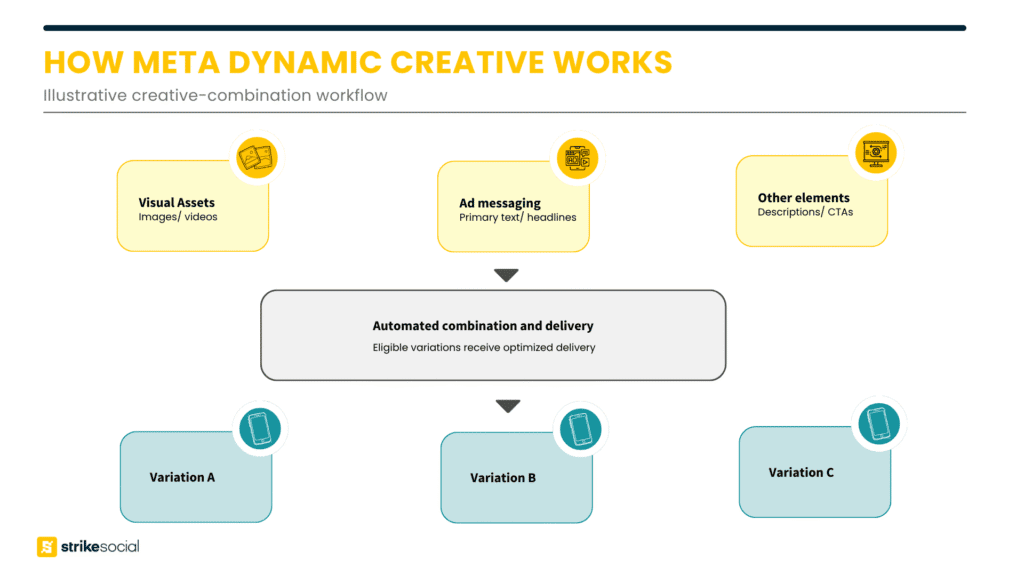
Meta Dynamic Creative is an advertising workflow that uses multiple creative assets supplied by the advertiser to produce different combinations for delivery. Rather than building a separate ad for every image-and-copy pairing, advertisers can provide a collection of creative elements and allow Meta’s delivery system to determine which eligible combinations to show.
The core creative inputs historically associated with Dynamic Creative include:
- Images or videos
- Primary text
- Headlines
- Descriptions
- Call-to-action options
For example, a retailer preparing a Thanksgiving promotion might develop three visual approaches: a product-focused image, a lifestyle image, and a short demonstration video. The advertiser could then supply compatible promotional messages and calls to action. The important word is compatible.
If one headline promises a specific discount while another visual displays a different offer, an automatically assembled pairing could misrepresent the promotion. Every asset should make sense alongside the other eligible elements.
Does Meta Dynamic Creative Test Every Possible Combination?
Advertisers should not assume that every mathematically possible combination receives equal delivery. Automated delivery is designed to optimize toward the campaign’s objective, not to produce a balanced scientific experiment.
Consequently, the results should not be interpreted as proof that one individual headline or visual would outperform another under identical conditions. If an advertiser needs to establish whether a specific creative concept causes a measurable improvement, a controlled experiment is more appropriate.
For a deeper explanation of experimental methodology, see Strike Social’s guide to A/B testing for social media advertising.
Media buyer’s perspective: Use automated combinations to explore creative delivery opportunities, but keep controlled testing separate from performance optimization.
How Does TikTok Automate Creative Optimization Work?
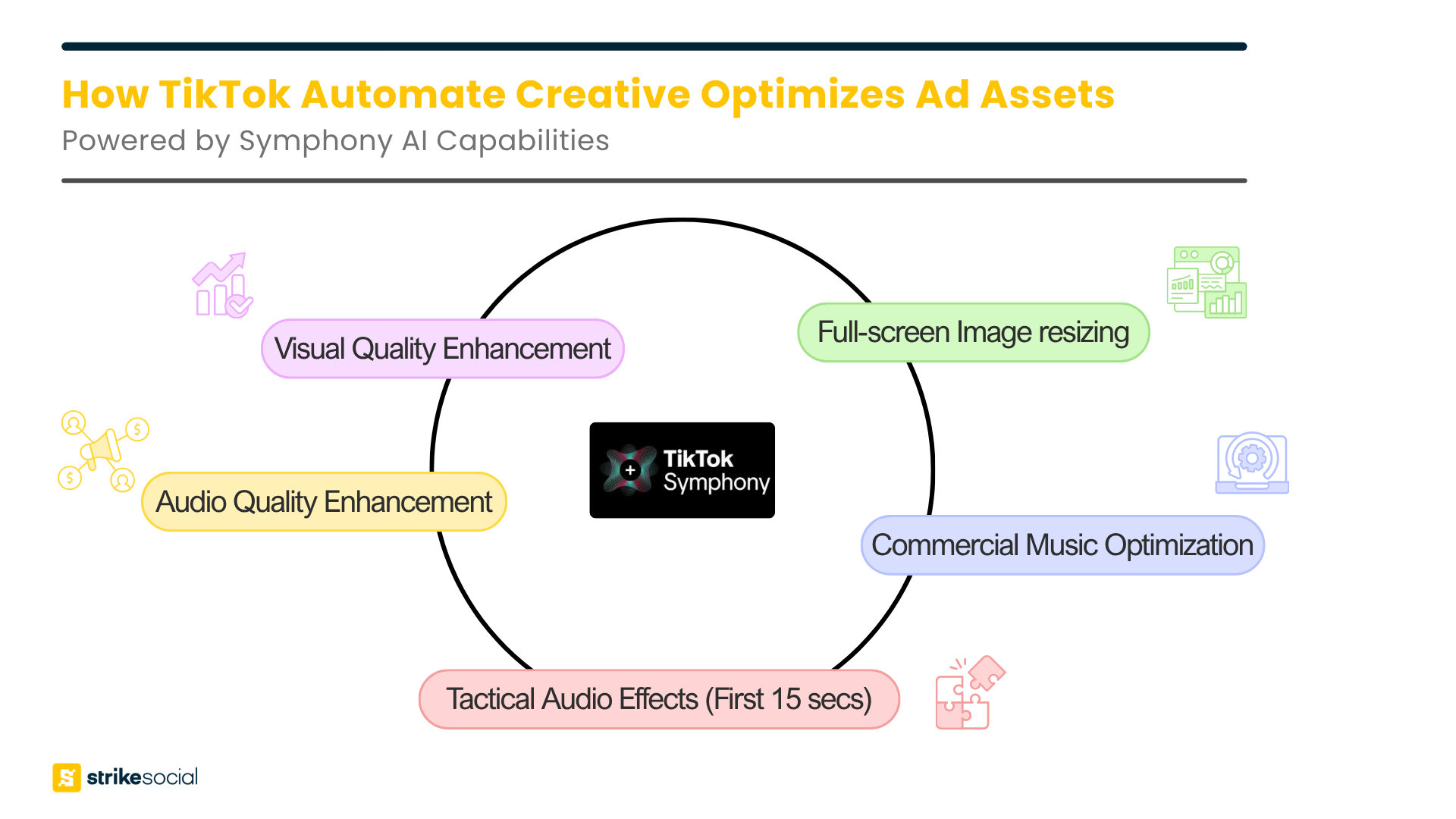
TikTok Automate Creative is an advertising optimization solution that uses Symphony AI capabilities to enhance advertiser-uploaded creative assets.
According to TikTok’s September 2026 documentation, its creative enhancement features include:
- Quality enhancement: Improvements to the visual and audio quality of uploaded creative assets.-
- Music enhancement: Recommendations and substitutions using music from TikTok’s Commercial Music Library.
- Image resizing: Adjustments intended to make better use of the available full-screen viewing area.
- Audio effects: Effects added around key selling points or transitions within the first 15 seconds of videos.
TikTok also identifies additional creative AI features being tested with portions of its advertiser base. These capabilities are particularly relevant when advertisers have usable creative assets but want to adapt or improve their presentation.
For a Thanksgiving campaign, a brand might upload a product demonstration video and evaluate whether supported audio or visual enhancements improve its presentation. The brand remains responsible for checking that the final creative accurately represents its offer.
Is TikTok Automate Creative the Same as Automated Creative Optimization (ACO)?
Not necessarily. TikTok’s earlier Automated Creative Optimization terminology and its Smart Creative documentation are associated with creative combinations and automated optimization.
TikTok’s November 2025 Smart Creative documentation describes a workflow involving the combination of video or image assets, text, and calls to action, followed by creative selection and fatigue-management mechanisms. That documentation also states that select advertisers may encounter a newer version called Automate Creative.
However, TikTok’s September 2026 Automate Creative documentation emphasizes AI-assisted creative enhancements. Advertisers should therefore avoid assuming that historical ACO functionality, Smart Creative behavior, and the current Automate Creative feature set are interchangeable.
For additional context on how creative automation has evolved, read Strike Social’s discussion of AI in social media advertising, including its earlier coverage of TikTok Automated Creative Optimization.
The correct interpretation depends on the product documentation, campaign configuration, and functionality available in the advertiser’s account.
Meta Dynamic Creative vs TikTok Automate Creative: Key Differences
The distinction is not that one platform is inherently more effective than the other. They address different parts of the creative optimization process.
Meta’s Dynamic Creative workflow focuses on how advertiser-supplied elements can be assembled and delivered. TikTok Automate Creative’s currently documented features focus on improving the presentation of uploaded creative materials. An advertiser may benefit from either approach, but the decision should begin with the actual creative problem being solved.
Further Reading
Turn creative optimization insights into a campaign plan
Finding the right ad combination starts with creative assets that work together. Our guide breaks down Meta Dynamic Creative Optimization and TikTok Automated Creative Optimization, from supplying assets to delivering ad variations.
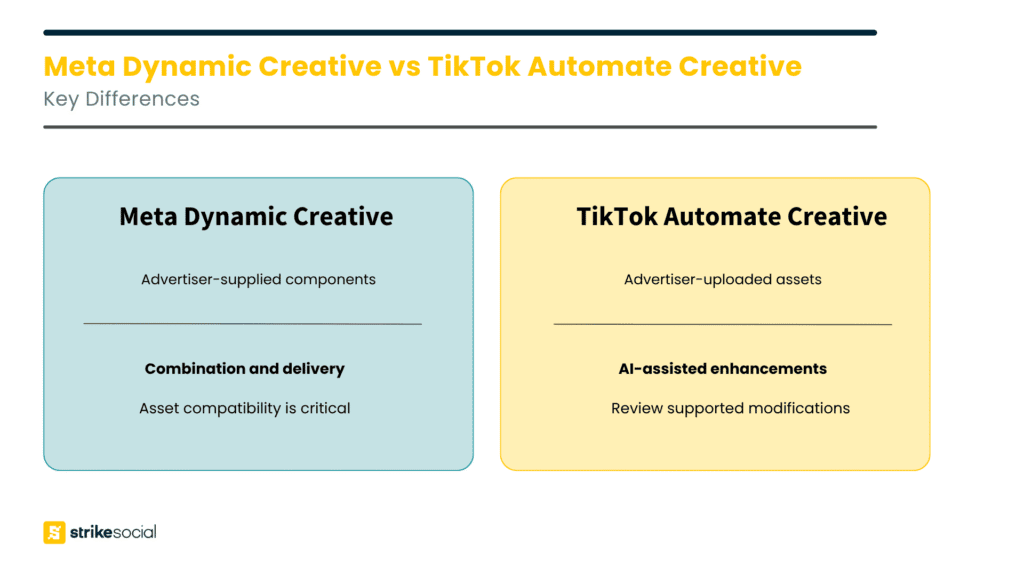
| Comparison | Meta Dynamic Creative | TikTok Automate Creative |
| Primary Approach | Combining supplied creative elements | AI-assisted enhancement of uploaded assets |
| Typical inputs | Images/videos, text, headlines, descriptions, CTAs | Uploaded videos and images |
| Optimization emphasis | Eligible combination delivery | Creative presentation improvements |
| Advertiser control | Asset selection and compatible messaging | Uploaded assets and available enhancement settings |
| Testing | Not a substitute for controlled A/B Testing | Split testing not supported within Automate Creative per TikTok’s September 2026 documentation |
| Main consideration | Creative compatibility and measurement interpretation | Feature availability, settings, and output review |
What Should Advertisers Supply and Control?
Creative automation works best when advertisers provide a coherent creative strategy. Before enabling any automated feature, media buyers should establish three things.
1. The Message That Must Remain Consistent
Promotional terms, prices, eligibility, product claims, and landing-page information should remain accurate across every permitted variation. This is particularly important during holiday sales, when offers can change quickly.
2. The Creative Elements That Can Vary
Advertisers should distinguish between assets intended to explore different messages and assets intended to improve presentation.
For example:
- Different product benefits represent messaging variation.
- Different video openings represent creative-concept variation.
- Audio enhancement or image resizing represents presentation optimization.
These changes should not automatically be treated as equivalent tests.
3. The Performance Signals That Matter
A video-view campaign, a traffic campaign, and a conversion campaign may require different success criteria. The creative that generates attention is not necessarily the creative that produces efficient conversions.
Media buyers should evaluate results against the selected objective and the quality of the measurement setup.
Creative Testing, Reporting, and Limitations
A common mistake in automated creative optimization is assuming that the platform has conducted a complete experiment on behalf of the advertiser. Automated delivery systems make optimization decisions within their supported configurations. They do not necessarily provide equal exposure to each variation or isolate the causal contribution of each asset.
A practical measurement framework should separate three levels of analysis.
- Campaign performance: Did the campaign improve against its actual objective, such as cost per acquisition, conversion volume, or return on ad spend?
- Creative delivery: Which creative assets or variations received delivery, and what information does the platform make available about them?
- Creative learning: Which insights are sufficiently supported to inform the next production cycle?
Advertisers should be especially careful with the third level. A creative asset receiving more delivery does not, by itself, prove that it is universally superior. Delivery can reflect platform predictions, audience conditions, bidding, and other factors.
When causal evidence is required, use a suitable controlled testing methodology rather than interpreting automated delivery as an experiment.
What About Creative Fatigue?
Creative fatigue becomes a concern when repeated exposure and changing audience responses contribute to weaker performance. Automated creative features may help advertisers manage variation, but they do not remove the need for fresh concepts, accurate messaging, and ongoing performance analysis.
For a deeper discussion, read Strike Social’s guide to identifying and preventing creative fatigue in Meta and TikTok ads.
Thanksgiving 2026: Preparing Creative Variations Before the Holiday Rush
Thanksgiving advertising offers a useful example of why creative preparation matters. According to the National Retail Federation, approximately 202.9 million consumers shopped during the five-day Thanksgiving-to-Cyber-Monday period in 2025. That is a historical measure of consumer participation, not a forecast for 2026.
For advertisers, the implication is practical: holiday creative planning should account for changing promotions, competing messages, and the short period available to identify operational problems.
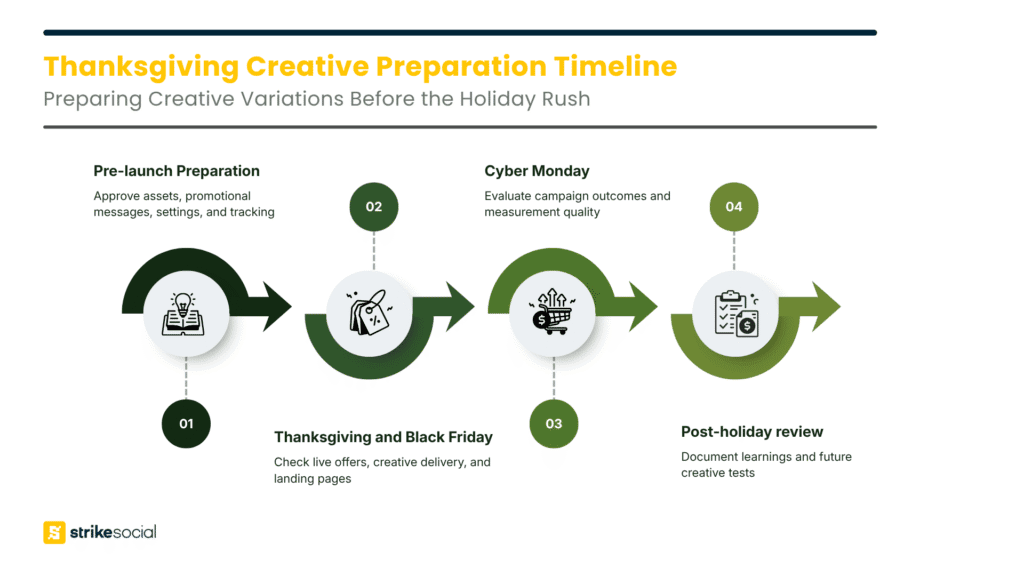
Before Thanksgiving: Prepare the Creative System
Build a set of approved visual concepts, promotional messages, landing pages, and tracking conventions. For Meta, check whether eligible creative elements can be combined without producing contradictory claims.
For TikTok, review the uploaded assets and decide which available Automate Creative enhancements are appropriate. Do not assume that automation will correct weak positioning, unclear offers, or poor source footage.
During Thanksgiving and Black Friday: Protect Message Accuracy
Promotions can change throughout the shopping weekend. Make sure every live creative variation reflects the correct offer, price, expiration date, and landing-page experience.
TikTok’s current documentation states that Automate Creative settings cannot be changed after a campaign is published. Advertisers must create a new campaign to use different Automate Creative settings. That makes configuration review especially important before launch.
During Cyber Monday: Evaluate Performance Against the Objective
Avoid declaring a creative winner based on a single engagement metric. Review campaign outcomes, delivery patterns, conversion tracking, and any relevant attribution limitations.
Document which findings justify another test and which observations remain inconclusive.
After the Holiday: Preserve the Learning
The value of holiday creative optimization should extend beyond the event itself. Record which creative concepts were used, which variations were eligible for delivery, which changes were introduced, and what performance evidence supports future decisions.
This turns seasonal execution into a more repeatable creative planning process.
When Should Advertisers Use Each Creative Workflow?
Use Meta Dynamic Creative where the workflow is available and the objective is to provide multiple compatible creative elements for automated combination and delivery.
Consider TikTok Automate Creative when the campaign is eligible and the advertiser wants to apply supported AI-assisted enhancements to uploaded assets. Use a controlled experiment when the primary question is whether a specific creative treatment produces an incremental improvement.
These approaches are not mutually exclusive across an advertiser’s broader strategy, but their results should not be interpreted in the same way. For advertisers managing both platforms, the goal should be a consistent creative strategy with platform-specific execution.
Frequently Asked Questions
What is the difference between Meta Dynamic Creative and TikTok Automate Creative?
Meta Dynamic Creative is associated with combining advertiser-supplied creative elements into ad variations. TikTok Automate Creative’s September 2026 documentation focuses on AI-assisted enhancements to uploaded assets, including visual quality, music, resizing, and audio effects.
Is TikTok ACO the same as Automate Creative?
The names should not be treated as automatically interchangeable. TikTok’s historical ACO and Smart Creative materials describe creative combination and optimization workflows, while the current Automate Creative documentation emphasizes supported AI enhancements. Advertisers should verify which feature is available in their accounts.
Does Meta Dynamic Creative automatically find the best ad combination?
Meta’s delivery system can optimize the distribution of eligible creative combinations, but that does not mean every possible pairing receives equal exposure or that the advertiser obtains a controlled, statistically validated winning combination.
Can TikTok Automate Creative be used with Spark Ads?
TikTok’s September 2026 documentation lists push Spark Ads among supported formats, alongside eligible non-Spark video and carousel ads. Availability depends on the campaign’s supported settings.
Can advertisers change TikTok Automate Creative settings after publishing?
No. TikTok states that Automate Creative settings, including whether the feature is enabled, cannot be changed after campaign publication. A new campaign is required to use different settings.
Does TikTok Automate Creative support split testing?
TikTok’s September 2026 help documentation states that split testing is not yet supported within Automate Creative.
How can advertisers prevent creative fatigue during Thanksgiving campaigns?
Prepare genuinely different creative concepts before launch, monitor objective-specific performance, maintain accurate promotional messaging, and develop a process for refreshing assets. Automated creative features can support that workflow, but they do not replace creative planning or performance analysis.
Final Takeaway: Automation Works Better With a Creative Strategy
Meta Dynamic Creative and TikTok Automate Creative demonstrate that creative optimization is not a single, standardized process across advertising platforms.
The more important question is not which platform automates more. It is whether the advertiser understands what the platform is optimizing, which decisions remain under human control, and what the resulting performance data can legitimately demonstrate.
For Thanksgiving, Black Friday, and Cyber Monday campaigns, that understanding helps teams prepare assets, review automation settings, maintain promotional accuracy, and extract more useful learning from their campaigns.
At Strike Social, our approach to paid social advertising starts with connecting creative decisions to campaign objectives, measurement, and ongoing optimization.
Ready to take your next creative campaign further? Strike Social can help you turn these insights into high-impact paid social campaigns for your seasonal push.

Article by
Lea Fidelino | Media Expert, Strike Social
Lea Fidelino is a media expert at Strike Social, specializing in paid social advertising strategy and campaign optimization. She brings a performance-focused perspective to navigating advertising platforms, evaluating creative strategies, and connecting campaign decisions with measurable business objectives.
Through her insights, Lea helps advertisers better understand evolving platform capabilities and make informed decisions about creative testing, automation, and campaign performance.


