

Overview
- Why early shopping signals mean Halloween advertising should start in discovery, not as a late-October burst.
- How creators, contextual placements, and product-led seasonal creative work together so that your Halloween campaign earns the consumers’ attention.
- A September-to-late-November CPM index sets cost expectations, then budget and measurement follow the real objective
Jump to Section
- When should brands start Halloween advertising in 2026?
- Halloween Marketing Campaign Ideas Matching 2026 Advertiser Priorities
- What Halloween Advertising Trends Show in Strike Social Performance Data
- Paid media trends shaping Halloween 2026 advertising
- Frequently Asked Questions
- Turn Halloween advertising trends into next week’s plan
Halloween advertising in 2026 starts before October. NRF data show roughly one-quarter of consumers had already bought at least one Halloween item by early August, which means Halloween marketing campaigns need early-discovery media, product-connected creative, and performance-led budget shifts, not a last-minute burst in late October.
This guide covers Halloween advertising trends media buyers should plan for: campaign timing, creator and audience relevance, social + CTV investment, product-feed discovery, seasonal creative, spend allocation, and measurement. It also links Strike Social’s highest-performing related guides (safe zones, ad specs, prior Halloween posts) so teams can execute without creative or delivery mistakes.
When should brands start Halloween advertising in 2026?
Start Halloween advertising when shoppers start deciding, not when costumes sell out.
NRF’s early-purchase snapshot shows early activity across candy, adult costumes, kids’ costumes, outdoor decor, pet costumes, and indoor decor. Treat that as category-specific timing, not one universal calendar:
| Halloween item | Purchased by early shoppers in 2026 |
|---|---|
| Candy | 34% |
| Adult costumes | 34% |
| Children’s costumes | 33% |
| Outdoor decorations | 28% |
| Pet costumes | 24% |
| Indoor decorations | 21% |
- Costumes: introduce complete looks in discovery, then push sizes, variants, and accessories.
- Decor: show finished displays, then make each product easy to shop.
- Candy / party: lead with pack size, occasion, and value.
Early buyers still make follow-on purchases (makeup, accessories, last-mile party needs). Your Halloween social media campaigns should map messaging to the next purchase.
Halloween Marketing Campaign Ideas Matching 2026 Advertiser Priorities
IAB projects U.S. social media ad spend to grow ~16.5% in 2026 and connected TV ~15.6%. In the same research cycle, advertisers report increased focus on:
| Advertising approach | Respondents reporting increased focus |
|---|---|
| Creator and influencer advertising or partnerships | 54% |
| Demographic and cohort-based advertising | 53% |
| Publishers with first-party data | 48% |
| Contextual advertising | 45% |
These are broader advertiser priorities, not Halloween budget allocations or performance forecasts.(Source: IAB’s September 2026 outlook)
Translate that into Halloween marketing ideas you can actually run:
- Creator transformations — costumes, makeup tutorials, porch makeovers with clear product callouts.
- Contextual seasonal placements — sit next to Halloween content where the product completes the occasion.
- Cohort targeting — parents, pet owners, “kidult” / fandom buyers, last-minute party hosts.
- Proof-led offers — newness + value (e.g., assortments that mix exclusives with sub-$10 decor), shown in-feed—not only claimed in copy.
The creative still needs a clear connection to the product. A recognizable Halloween theme may attract attention, showing how the product helps complete a look or celebration, giving that attention a commercial purpose. Strike Social’s Halloween influencer campaign guide explores how to bring those collaborations into paid campaigns.
What Halloween Advertising Trends Show in Strike Social Performance Data
Strike Social Performance data is built from aggregates across hundreds of millions of impressions from 2023 through 2025. Figures reflect campaign mix, objectives, creative, and buying setup. Use them as Strike planning signals, not a universal market rate card.
In the Halloween window, year-over-year CPM remained relatively stable in the mid-$7s, with US campaigns leveraging impressions, while cost-per-view improved about 38% from 2024 to 2025.
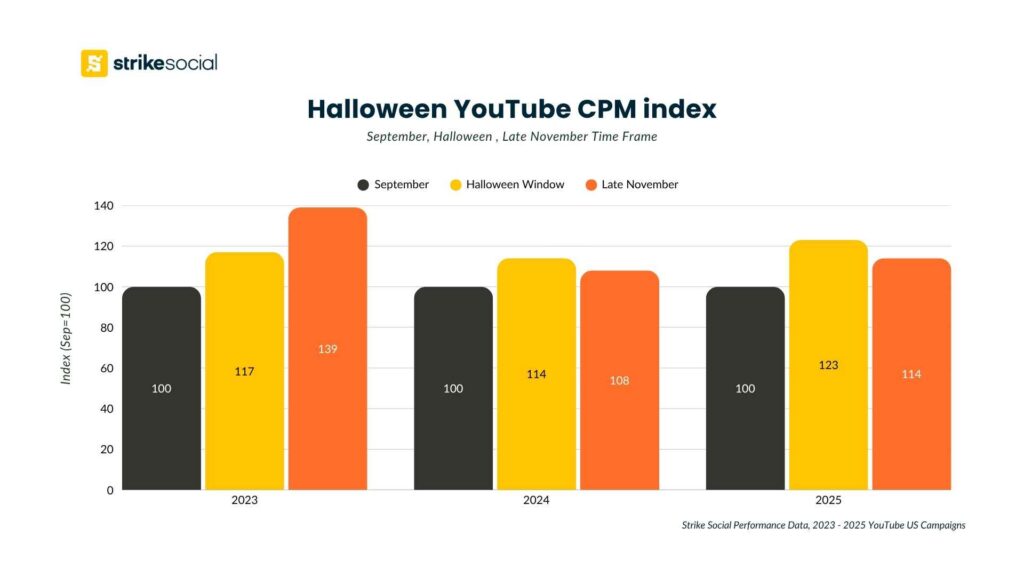
Strike Social Performance data (U.S.) · September = 100 · Index only · Hundreds of millions of impressions across 2023–2025 · Not a rate card · We are not exposing actual CPM on this chart.
Further Reading
Turn Halloween influencer posts into paid social that still feels organic
Strike Social’s Halloween boosting guide walks through the organic-to-paid model: brief creators for authentic assets early, then scale winners with TikTok Spark Ads, Instagram Partnership Ads, and YouTube formats so the same content that performs organically can carry paid Halloween flights into broader Q4.
Paid media trends shaping Halloween 2026 advertising
Social and CTV investment is growing
IAB’s September update projects U.S. social media advertising spending to grow 16.5% in 2026 and connected TV spending to grow 15.6%. Both forecasts exceed their January projections.
Build the channel plan around the campaign’s job. For Meta, TikTok, or YouTube, establish that purpose before assigning spend. Also consider whether the team has suitable creative and enough budget to evaluate the channel. Spreading a small test across every platform can leave each campaign with too little evidence to guide the next decision.
Connect visual discovery with products that shoppers can explore
In its retail holiday strategy session, Google recommends looking beyond the click immediately before purchase. The discussion describes using Demand Gen alongside Shopping or Performance Max to support discovery through visual advertising.
Demand Gen campaigns can use a Google Merchant Center product feed to pair image or video creative with browsable product imagery. For a Halloween retailer, that creates a route from seeing a costume or decorated space to exploring the products featured in it.
A home decor advertiser, for example, could show a finished Halloween porch alongside relevant products. A costume brand could demonstrate an outfit in motion and feature the available items.
Product data needs to support that experience. Check that prices, variants, and availability match the landing page, particularly as popular items sell out or promotions change. Google requires key landing-page information to agree with the submitted product data. Merchant Center requirements
Give seasonal creatives a clear value proposition
Target’s 2026 Halloween assortment combines newness with accessible pricing: nearly 70% of the collection is new, about 60% is exclusive, and 60% of the decor is priced below $10
For a highly anticipated event celebration, a merchandising approach offers a useful creative direction. Well-crafted creative approach on both physical and digital advertising can help the product to become extinve that is how the product became distinct and what the customer receives for the price.
In paid social, this could mean comparing a finished display reveal with a setup demonstration or a clearly priced bundle. Keep the offer consistent when testing the message so the results provide a useful basis for creative decisions. Creator content can support these tests when it demonstrates the product clearly and suits the campaign objective.
Keep Halloween performance connected to business results
Score the campaign against the objective you set in September. Reach and engagement explain response. Purchase cost and revenue explain commercial outcomes. Leave room for conversion lag, and keep attribution settings visible when you compare platforms.
Carefully carry Halloween learning into broader Q4 planning. Strong engagement alone should not automatically fund a holiday sales budget. Reinvest where acquisition costs, product economics, and the next offer still make sense.
Frequently Asked Questions
When should brands start Halloween advertising on YouTube?
We recommend locking a September baseline early, then pace the October 15–November 5 Halloween window harder. Do not wait for a late-October-only burst.
What are the Halloween advertising trends for YouTube in 2026 planning?
In Strike Social Performance data, the Halloween window exceeds September — recently about 14–23% higher on an index basis — with Skippable In-Stream and Video View campaigns accounting for most spend.
Does the November ad cost reset after Halloween?
Not always. November-late stayed above September in recent years; 2023 climbed further into holiday pressure.
Turn Halloween advertising trends into next week’s plan
A practical Halloween advertising plan connects shopper evidence to decisions you control: offer, creative, timing, budget, and measurement.
Watch for early shopping signals to time your launch. Set your cost expectations trends from September through late November. Shift your budget based on live performance, and always judge results against your real objective.
Need a channel-ready Halloween plan? Strike Social can help you turn these insights into high-impact paid social and YouTube campaigns for your seasonal push.


