

Strike Overview
- ChatGPT ads are here: Beta testing is live in the U.S., signaling that other AI platforms may soon open to advertisers looking to capture early opportunities.
- How AI ad inventory will look: Formats differ from traditional paid social, such as YouTube ads, offering both familiar elements and unique ways to engage users.
- Preparing for ads on AI: Ads on AI engines are coming, and brands that structure data, optimize content, and build authority now will gain a competitive advantage.
Jump to Section
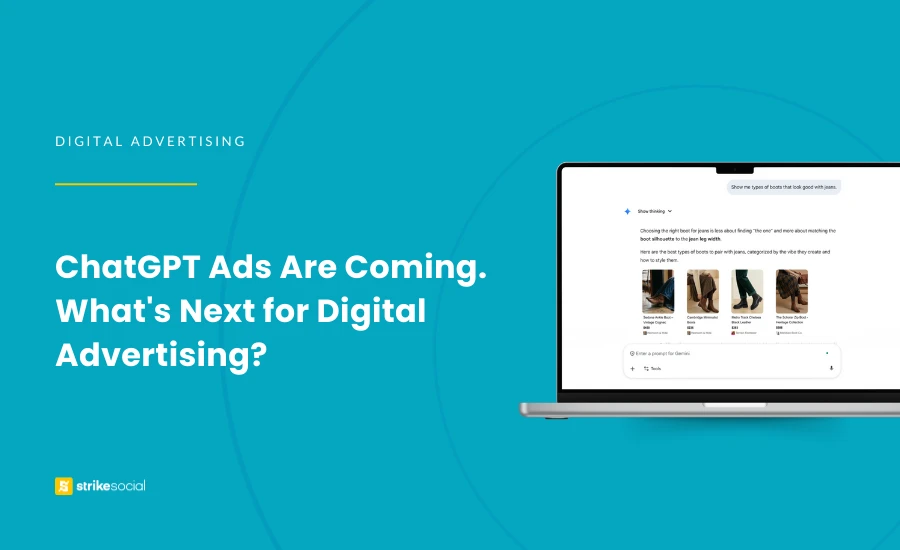
ChatGPT Ads Are Coming. What’s Next for Digital Advertising?
ChatGPT ads represent the most significant disruption to the pay-per-click (PPC) model, at least so far.
For more than two decades, digital advertising has operated on two primary rails. Search, where users type a keyword, and advertisers bid to appear, and Social, where users scroll a feed, and brands compete for viewers’ attention. The rise of GenAI, answer engines, and AI-powered platforms like ChatGPT, Perplexity, AI overviews, and the Gemini app is now creating a third rail: intent-based utility.
This new behavior fundamentally changes how consumers discover brands. Instead of clicking through multiple links, users are increasingly relying on AI to generate answers, recommendations, and comparisons in real time. In many cases, the AI response is the destination. For Gen Z users alone, more than half now use AI for product discovery, and roughly 39% of consumers overall report doing the same. If your brand isn’t present in that generated response, it’s effectively invisible.
That’s why ChatGPT ads and broader ads on AI platforms are signaling a redefinition of search ads altogether. Below, we break down the growing role of AI-powered advertising across answer engines, along with what advertisers should be doing now to prepare for the next shift in digital advertising.
The New Ad Platforms in Town
AI-powered advertising is already here, but it’s fragmented. Each platform takes a different approach to monetization, meaning strategies that worked for search or social may not translate directly to ads on AI. While headlines focus on when these ads will arrive, in reality, some platforms are already running campaigns, and others are preparing to launch.
1. OpenAI
Status: Live (US Rollout)
OpenAI has officially begun testing ads on ChatGPT in the United States. However, they are avoiding the interruption model of traditional banner ads.
- Cost of Entry: Early reports indicate a CPM (Cost Per Mille) in the $60 range. To put that in perspective, that is roughly 12x higher than our 2025 CPM benchmarks and aligns more closely with premium ad spots than standard digital display.
- Ad Format: Ads appear as sponsored suggestions within the conversation. For example, if a user asks, “What should I prepare for a dinner party?” a brand may be incorporated directly into the AI’s answer as a suggested ingredient or product. The ad becomes part of the solution.
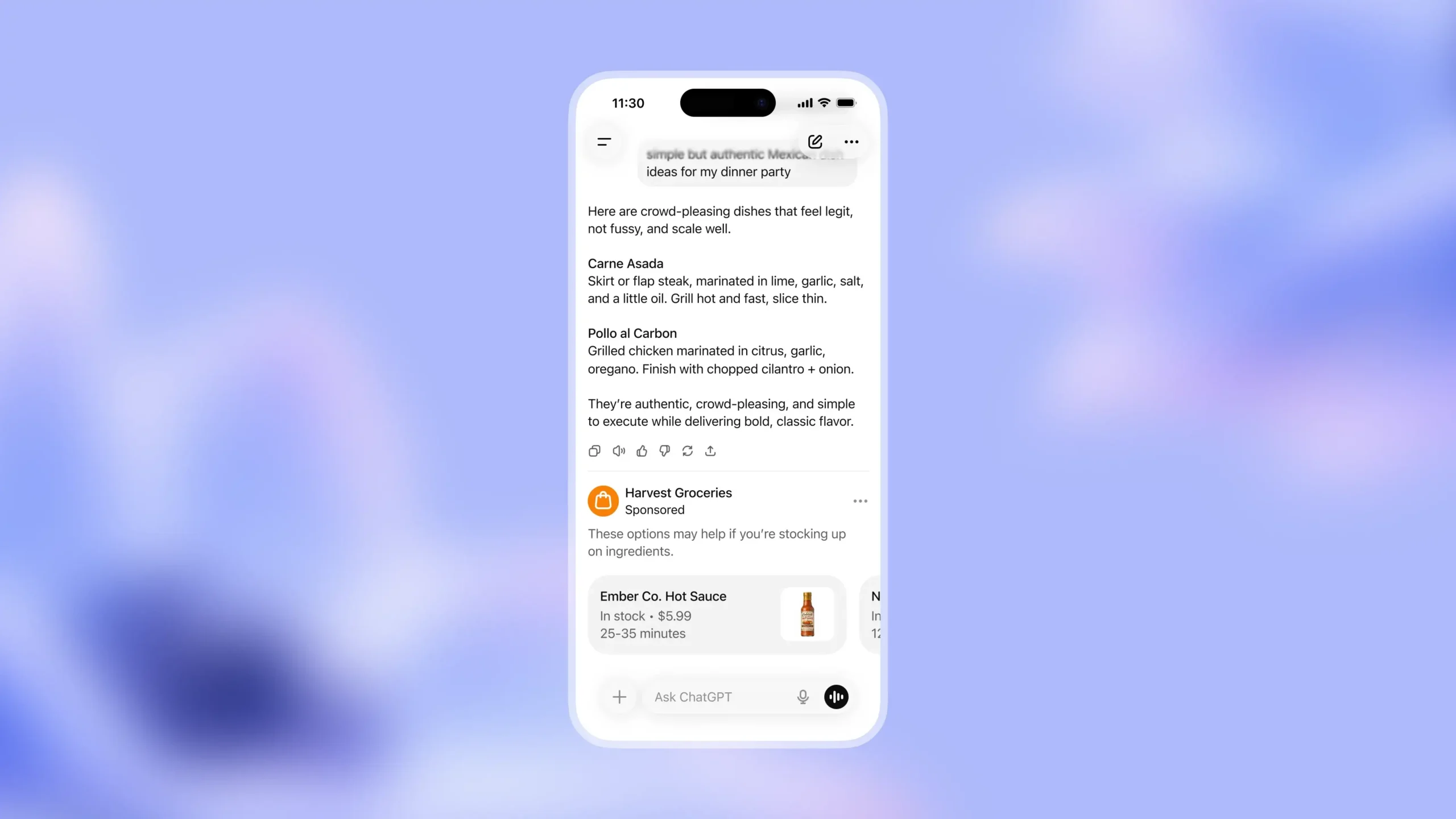
- Strategy: OpenAI’s approach aligns with utility-driven marketing. Advertisers can’t simply bid on keywords; they need content on landing pages or product pages that directly answers the queries users are asking AI. Brands that focus on informative descriptions are more likely to be surfaced in AI-generated answers.
2. Perplexity
Status: Paused
Perplexity, a challenger in AI answer engines, aggressively launched ads in 2024. However, in late 2025, they paused onboarding new advertisers.
GenAI search results already face trust issues: users trust only 14% of AI-generated results. Advertisers struggled because Perplexity lacked robust tools to measure click-through rates (CTR), return on ad spend (ROAS), and other KPIs, making early campaigns difficult to optimize.
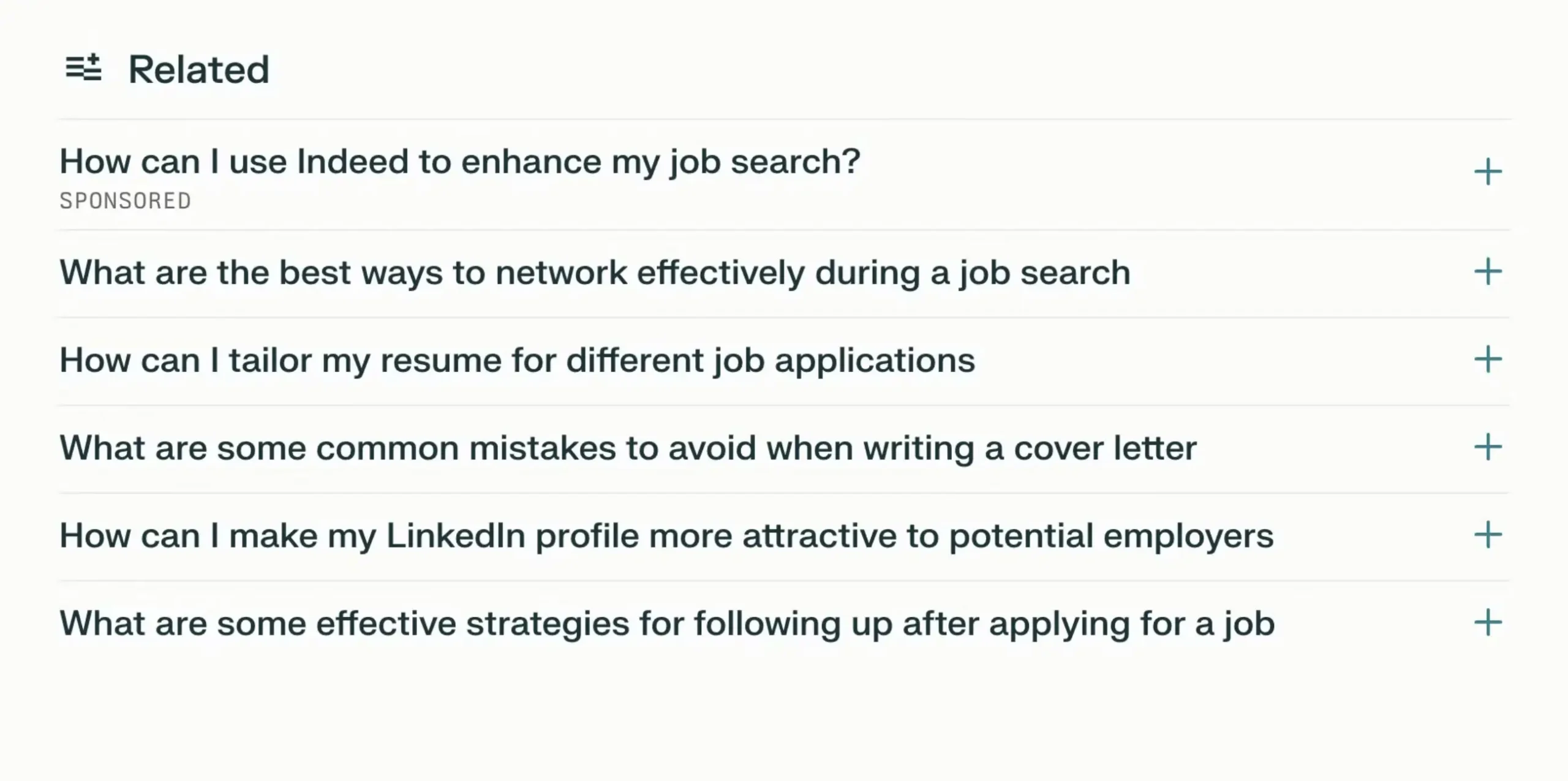
- (Previous) Ad Format: Sponsored follow-up questions appeared in the “Related Questions” section. Clicking one would generate an AI-powered answer influenced by the brand, leading users to the advertiser’s landing page or product reference.
- Opportunity: Despite the early pause, Perplexity now has preliminary data on AI search behavior and ad performance. With a new advertising chief and a more structured approach, Perplexity ads are expected to return as a more refined, advertiser-friendly platform.
3. Google
Status: Inactive
Google executives often deny that ads will appear in Gemini to ease users’ minds, but make no mistake: it can happen sooner than you think.
- AI Max for Search: Brands running AI-powered campaigns via Google’s AI Max for Search or Performance Max are already participating in AI advertising. These tools use Search Term Matching and Asset Optimization to dynamically align ads with conversational queries, exactly the types of prompts that generate AI overviews.
- Gemini App: Google is cautious about introducing advertising into its GenAI model, likely monitoring OpenAI’s experiments and Perplexity’s earlier challenges. There are currently no Gemini ads or ad integrations within AI overviews, but when ads arrive, early adopters will have a significant advantage.
Historically, major platform shifts reward early movers. Brands that test AI advertising during beta phases can achieve up to 40% lower CPAs than the mature-market average. Auction density is low, user curiosity is high, and early adoption can establish brand presence in an entirely new advertising ecosystem before competition intensifies.
Why AI Ad Inventory Will Change the Game
If your brand is already running sophisticated paid social and search advertising campaigns, why should you care about ads on AI? The answer lies in the nature of the “ask” itself.
Context vs. Keywords
Traditional search advertising relies on keywords. If a user types “running shoes,” it’s unclear whether they’re researching, buying, or just browsing for images.
AI-powered advertising, on the other hand, utilizes context. Imagine a user has been discussing “training for a marathon” with ChatGPT and then asks for shoe recommendations. The AI doesn’t serve a generic ad; it displays a targeted ad for stability running shoes that fits the user’s exact scenario. By using the conversational history, AI platforms deliver far more precise intent-based opportunities for advertisers.
The Zero-Click Threat
One of the biggest risks for brands in GenAI search is the rise of zero-click experiences. AI synthesizes information from multiple top-ranking sources and delivers the answer directly to the user, often without sending them to your website.
To stay visible, brands must shift from optimizing for clicks to optimizing for citation. Being a source that AI references builds authority, and as ChatGPT ads and AI search ads evolve, advertising may become the primary way to appear in AI-generated answers when organic coverage is insufficient.
AI Audience Targeting
The rules of targeting are changing. Traditional identity-based methods rely on cookies or personal data, but advertising on AI focuses on real-time intent: what the user wants right now.
This form of AI audience targeting is inherently privacy-compliant. The platform doesn’t need to know who the user is; it only needs to understand the conversation they are having. For advertisers, this means campaigns can be hyper-relevant, privacy-safe, and aligned with users’ current needs, all without relying on personally identifiable information.
Further Reading
Advantage+ Audience or Manual Targeting: Which Works Better?
Advantage+ Audience has become a standard part of the Meta advertising toolkit, yet results vary widely depending on how it’s deployed. While automation can drive efficiency at scale, it can also introduce performance volatility when oversight is limited. The real difference is knowing which approach fits your objective, data maturity, and level of control required for each campaign.
How Should Brands Prepare for Advertising on AI Platforms?
You don’t need to wait for ChatGPT ads to go live to start preparing. The data and content you structure today will determine your win rate when AI ad platforms open their auctions. As conversational AI platforms evolve, brands are also seeing the rise of AI-powered sales workflows, including the adoption of AI SDR systems that automate prospect engagement and qualification across digital channels.
Here are key strategies to future-proof your paid media and AI advertising approach:
Structure Your Data With The Language of AI
Ads on AI rely heavily on structured, descriptive data. A messy product feed or generic titles make it difficult for AI to understand your product’s utility.
- Audit your product feeds: Are your titles generic (“Men’s Shoe”) or detailed with attributes (“Best for: Marathon, Material: Pebax-powered foam, Compatibility: Orthotic-friendly”)?
- Enrich with conversational attributes: Think about how a user would describe their problem and how your product solves it. Solution-oriented, descriptive product descriptions help AI surface your brand in responses. Structured feeds increase the likelihood your product appears in ChatGPT ads, Perplexity ads, or other AI-powered recommendations.
The “Inverse Pyramid” Content Strategy
AI prioritizes speed and direct answers. Unlike traditional long-form landing pages, AI crawlers and answer engines reward content that directly answers user queries.
- Place the solution at the top of your page rather than burying it in a 2,000-word webpage.
- Use long-tail keywords and natural language questions (e.g., “Best coffee pods compatible with Keurig”) to align with how users ask AI.
This strategy increases the chance that your content will be selected as the AI’s direct answer, or surfaced as a recommended product in ads on ChatGPT or other GenAI Search platforms.
Brand Authority as a Ranking Signal
Answer engines like ChatGPT and Perplexity prioritize credible, authoritative sources to maintain trust.
- Get your brand cited in reputable industry publications, news outlets, and lifestyle websites relevant to your sector.
- AI is more likely to reference brands it considers trustworthy, increasing your chances of appearing in ChatGPT ads or AI-powered recommendations. Strong citations also help your brand stand out in AI advertising ecosystems before competitive saturation sets in.
Visual Search Readiness
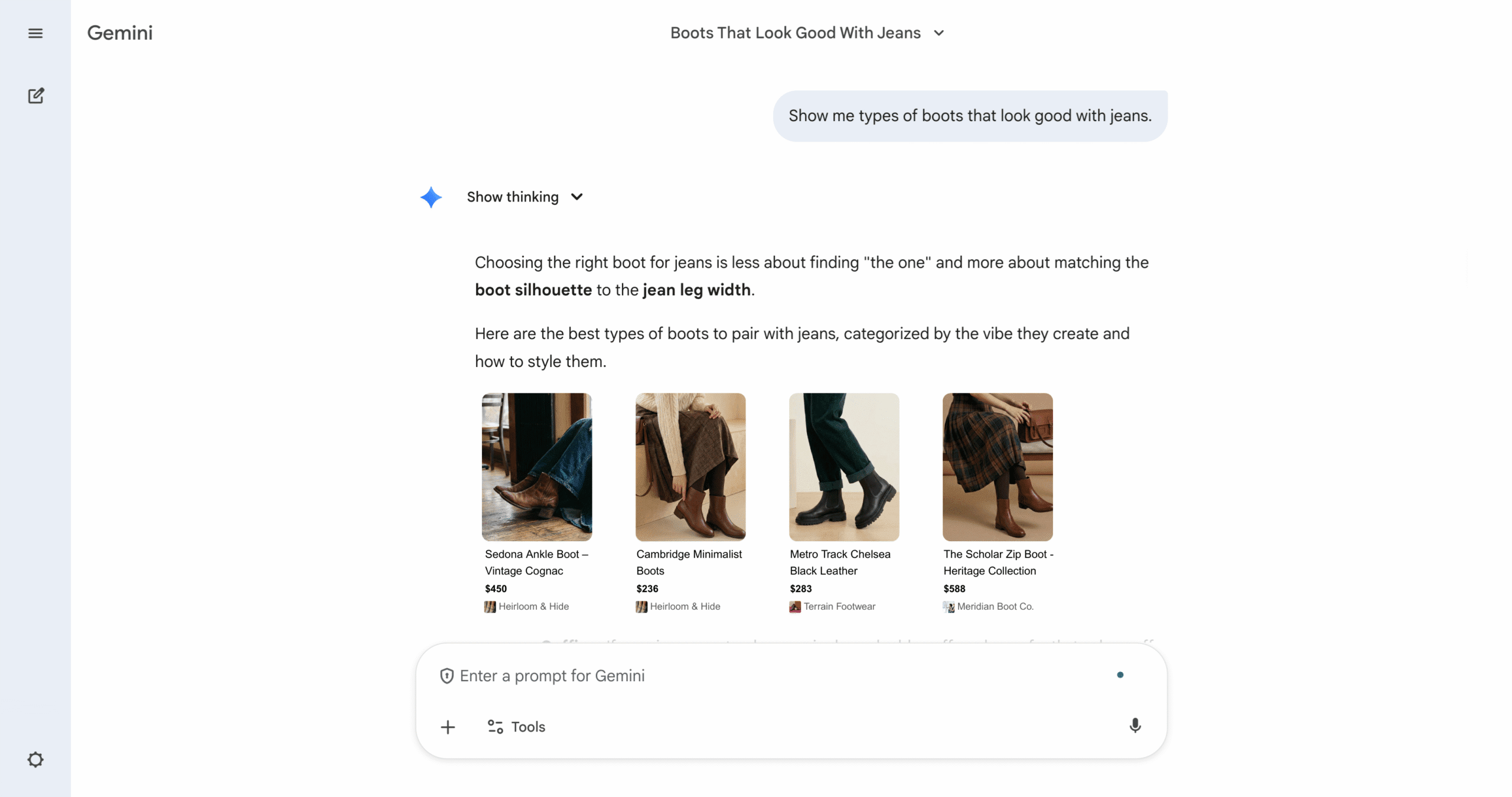
Search is evolving toward a more visual experience with tools like the Gemini app and Google Lens. Even though ads on AI engines like Gemini haven’t been confirmed yet, gaining visibility in this space should be a primary focus now.To prepare, ensure your creative assets are of high quality. AI models analyze images for context; for example, if your image clearly shows the product in use, the AI is better equipped to match it to a user query such as, “Show me boots that look good with jeans.”
FAQs on The Future of GenAI Advertising
ChatGPT ads and Perplexity ads will likely serve different purposes than traditional Google Ads.
Google Ads will remain dominant for navigational searches (e.g., “Nike website”), while ads on AI platforms will excel at discovery and solution-oriented queries (e.g., “What shoes are best for running a marathon?”). Brands that integrate into both ecosystems can capture both direct intent and AI-driven discovery opportunities.
With Perplexity ads having briefly launched and paused, and ChatGPT ads currently in beta testing, more GenAI platforms are expected to explore advertising in the near future. Advertisers should focus on getting discovered and cited within AI-generated answers today. Being referenced as an authoritative source or included in AI responses will be the first step to understanding how ads on AI will function and to staying ahead of competitors.
Social media feeds the AI ecosystem. Content you publish on platforms like TikTok, Facebook, or Instagram helps train AI models on your brand identity. Strong organic social signals increase the likelihood that AI will surface your brand in ChatGPT ads.
Paid social remains a separate domain, but paid search and AI advertising are evolving quickly. The brands that align their social content with AI-readiness today will have a strategic advantage when GenAI advertising becomes mainstream.
AI Search Ads, Advertisers’ New Perspective
Ads on AI represent a fundamental shift for brands already invested in paid search. We are moving from an era of buying keywords to a world where success depends on optimizing for answers.
The brands that will lead in this new landscape won’t necessarily have the largest budgets. They will have the cleanest data, the most informative content, and the strongest authority signals.
The window for early adoption is closing fast. The infrastructure for AI-powered advertising is being built now, and platforms like ChatGPT, Perplexity, and other GenAI search engines are preparing to monetize. By structuring your data, optimizing content for AI queries, and building brand authority, you are positioning your campaigns to perform in the next wave of ads on AI platforms, sooner than many competitors expect.

Article by
Lee Baler, Strike Social’s VP of Sales & Strategy
Lee leads global strategy, helping clients and agencies maximize YouTube and paid social performance. Constantly tracking industry trends, he translates insights into strategies that help brands stay competitive and achieve sustained profitability.


